


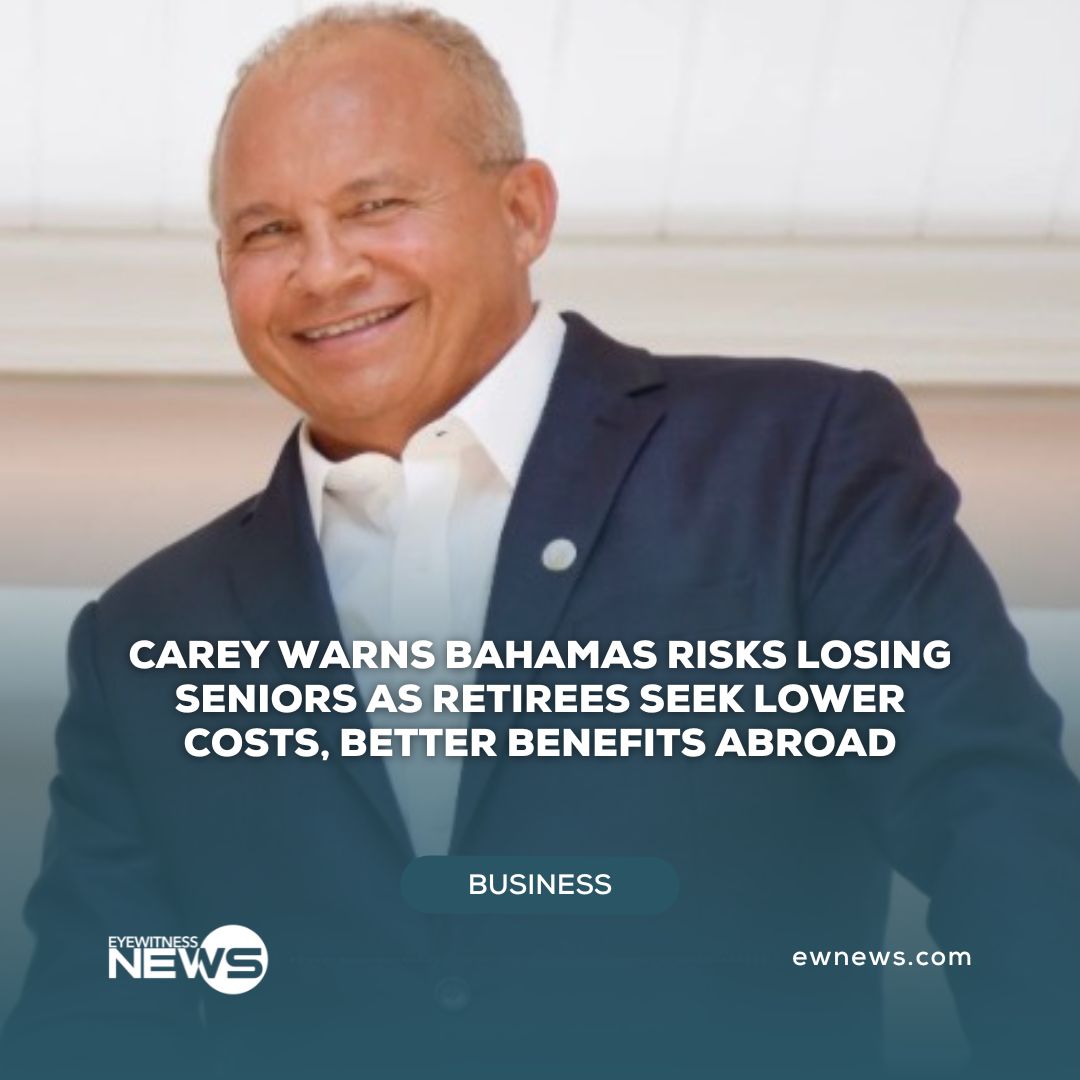
NASSAU, BAHAMAS; The Bahamas risks losing more of its senior citizens to countries offering a lower cost of living and greater retirement benefits unless policymakers move quickly to make ageing at home more affordable, leading businessman Mario Carey has warned.
Carey said increasing numbers of Bahamians and long-term residents are looking to spend their retirement years in countries such as Panama, Mexico, Costa Rica and Portugal, attracted by cheaper housing, healthcare benefits and extensive discounts for seniors.
“For the first time in our history, we are witnessing an exodus of Bahamian citizens and long-term residents who are finding that it is not better in The Bahamas when you get older,” said Carey. “They are exploring options and taking up residence in places like Panama, Mexico, Costa Rico and Portugal where the cost of living is lower and the benefits are greater.”
In Panama, he said, benefits range from essentials such as guaranteed insurance coverage and reduced pricing on prescription drugs to deep discounts on non-essentials such as movies and dining.
“In places like Panama it is not just that the rent on a beautiful residence is one-third what it would be for a similar property here, it is the way older people are treated – with reverence and appreciation,” said Carey. “When you walk into a restaurant or a coffee shop or any place of business, you are treated with extra respect. Here, we say we respect our elders and many families do look after their older members, it’s part of the culture, but it is not with the same respect where you are made to feel that you are truly valued and honoured because of your age.”
Carey’s comments come as The Bahamas considers the Older Persons Rights, Protection and Care Bill 2026, proposed legislation that divides responsibility between the Ministry of Social Services and the Ministry of Health and Wellness.
“The Bill is a very basic starting point. It pays lip service to ideas like “motivated by a genuine concern” but it does not address the economic realities including how hard it is for older people to maintain health insurance because the premiums keep climbing and the pension funds from National Insurance don’t begin to cover living expenses,” he said.
Carey argued that reforms should go further, including allowing seniors greater freedom to obtain insurance coverage overseas.
“We should not have exchange control over health insurance,” said Carey. “We should have the freedom and the right to purchase health or life insurance without interference from regulators. We can purchase an automobile, a TV set, send our children off to school abroad. Why are we not able to acquire insurance coverage if we can buy everything else we need where we want to? I would like to see that right added to the pending legislation.”
For Carey, who has handled nearly $3 billion in transactions during a highly successful career in real estate, his own personal experience opened his eyes to how many others were searching for places to call home outside the country where they had lived most or all of their lives.
“In Panama, legislation underpins the economic benefits for seniors – 30 percent discount on intercity buses, on trains, boats and ferries, 25 percent discount on hotels and airline tickets and hotels, 50 percent in restaurants Monday through Thursday, 15 to 20 percent on doctors’ or dental or optometry services and more.
Carey also pointed to The Bahamas’ recent electricity challenges as another example of the difficulties facing older residents.
“The power outages that have plagued The Bahamas this summer have been especially hard on the elderly, many of whom face mobility challenges,” he said. “Someone had the insensitivity to suggest that if the power is off, we all just go to the beach while too many have been left to sweat in the dark. What about the individual in a wheelchair, or those who have no transportation or extra money for a jitney? What about those people in the few senior homes we have? What are they supposed to do?”
Passing legislation making it an offence to cause mental or physical harm to an elderly person is just a first step, Carey said. He believes how the country treats the elderly requires an entirely fresh approach.
“We underestimate what we lose when older people choose to move to another country,” said Mr Carey. “These are our elders – they carry our knowledge, our wisdom, they provide guidance to the generations which follow.”
Competition for retirees is also increasing internationally, he said.
“There is a powerful campaign to seniors playing out in at least a dozen countries around the world, countries like Panama and Costa Rica, that are rolling out the red carpet for those over 60 or 65,” said Carey. “They are setting a trend, understanding how much value retirees can bring to their economy and their culture.”
Meanwhile, The Bahamas remains an expensive jurisdiction, particularly for seniors, with financial, medical and accessibility issues all a concern.
“The older we get, the more our medical costs increase,” said Mr Carey. “For many people, that becomes ever more difficult to afford. We see the challenges faced by our public healthcare facilities and the lengthy waiting times for patients, while we see what seems to be the ever rising costs of private healthcare. That can be a recipe for disaster for senior citizens – especially when you take into account the shortfall people are left with as national insurance and pensions don’t cover most people’s monthly costs.”
He added: “Even in the best of health, life can be difficult for senior citizens in The Bahamas – but many are not in the best of health. For example, the numbers show The Bahamas is facing increasing numbers of patients with dementia.”
Carey acknowledged The Bahamas offers some benefits for seniors, including a discount for Bahamians on Real Property Tax, although that disappears if a room is used for short-term rental income. There is also a slight discount on Water & Sewerage billing, while some banks offer reduced fees on current accounts.
Mr Carey compared that to Panama, where he said: “In Panama, there is a 50 percent discount on movies and entertainment for those over 65. You walk into a shop and it’s 10 to 20 percent off on everything from clothes to shoes, 10 percent on medications, 15 percent on hospital stays. Hotels and flights are heavily discounted. When you look at what we do compared to what some other countries are doing, it is hard to say we are really trying to encourage our older citizens to stay and to be able to pass on their knowledge and expertise to society.”
The cost of living in Panama is also far lower than the US, with consumer prices 35 percent lower and rent 56 percent lower, while a couple can live well on between $2,000 and $4,000 a month. Meanwhile, The Bahamas is frequently listed among the top countries for the high cost of living.
Other countries can also be attractive alternatives. Costa Rica has a strong universal healthcare system, no taxation on foreign income and a couple can live well on $2,800 a month. The cost of living in Greece is even lower, at less than $1,150 a month, with a Golden Visa through real estate investment available. Some well-known faces are among those joining the exodus, with senior figures in business among those relocating at least in part to Italy, Portugal and Canada.
“Some of these countries are going out of their way to make the most of their senior citizens. In The Bahamas, we do just the opposite – we make it very challenging to make ends meet once you leave the job and are supposed to be entering your golden years, you are relegated to finding ways to make ends meet,” said Mr Carey. “Your NIB payment is hardly enough to cover anything, you don’t have your career or job revenue, your insurance rates skyrocket or you may be cancelled or not qualify if you are no longer employed. Meantime, your medical expenses increase, health insurance rates can climb so high you cannot even afford to maintain it. You are too old to borrow money from the bank so you are strapped. We do not ensure that rules on accessibility are followed. Getting around with a cane or in a wheelchair is incredibly difficult with the lack of ramps and elevators.”
Carey suggested allowing reverse mortgages, which provide cash based on the equity in a property, with those who inherit the property left to repay what was borrowed.
“At least, you can enjoy the part of your life you worked all those years to be able to afford – being able to travel, pursue a hobby, or cover your medical expenses,” he noted.
“There is no other exit strategy for being a senior citizen. If The Bahamas wants to retain retirees – citizens, residents, investors, professionals – who in their retirement must take into account the basics of affordable health care, insurance, cost of living and lifestyle, we need to act now. There are Bahamians who never dreamed they would need to leave the country of their birth – but who are doing so because they cannot afford to stay. We hear time and again that it’s better in The Bahamas – but too often that’s not the case for Bahamians as they grow older.”