


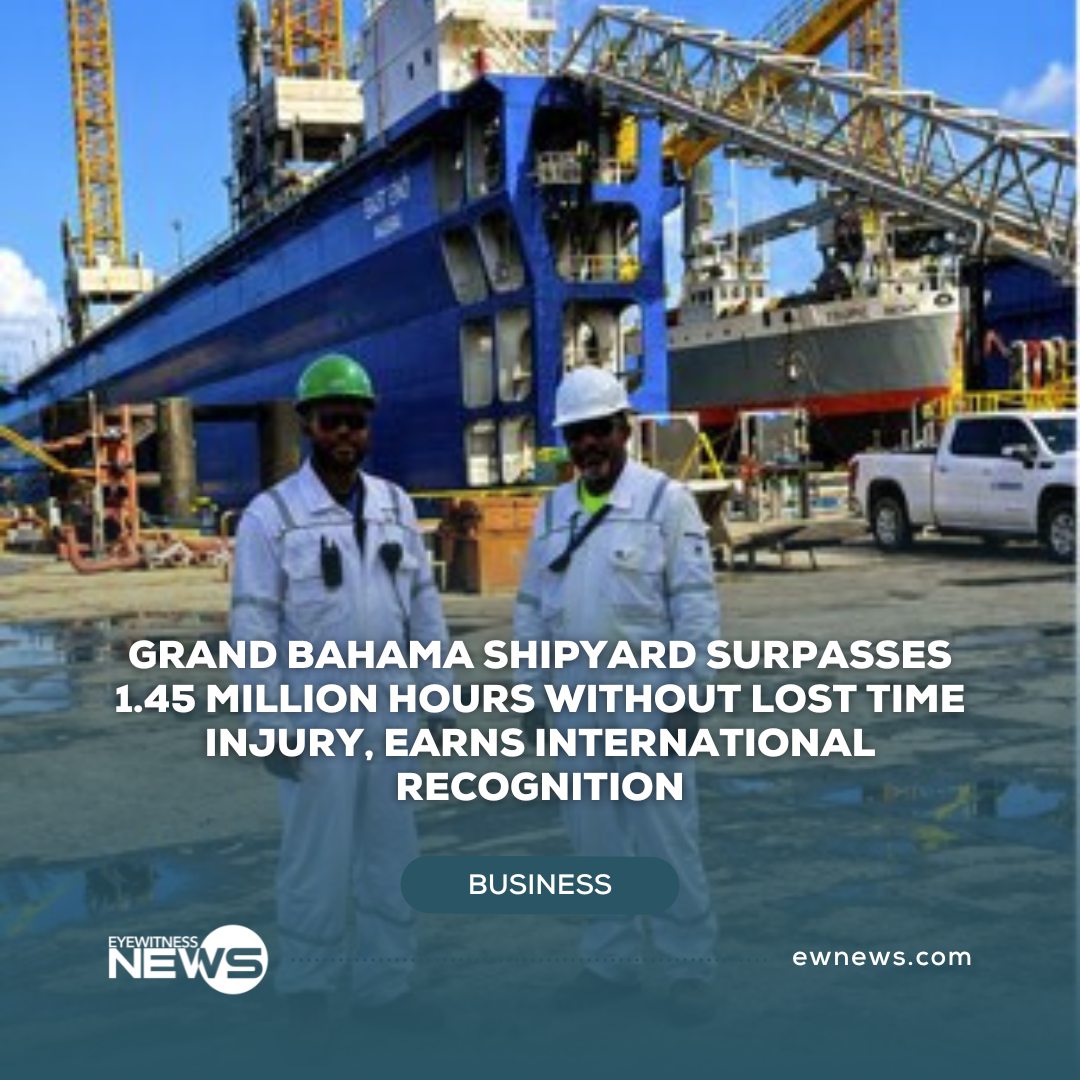
NASSAU, BAHAMAS: Grand Bahama Shipyard Limited (GBSL) has surpassed 1.45 million trade labour hours without a Lost Time Injury (LTI), marking another milestone in the company’s continued efforts to advance workplace safety.
The Shipyard reached the one-million-hour milestone on April 14, 2026, after completing 210 consecutive days without a Lost Time Injury. That achievement has continued uninterrupted, reaching approximately 1.45 million trade labour hours as of June 25.
The milestone comes during one of the Shipyard’s busiest operational periods, with projects often requiring multiple skilled trades to work simultaneously across different areas of a vessel. The company said safely coordinating these activities requires strong health and safety systems, careful planning, and a workforce committed to maintaining high standards every day.
The achievement reflects continued progress through Grand Bahama Shipyard’s Safety Absolute Program, active safety committees, employee engagement initiatives, and ongoing investment in training and workplace safety.
The company has also received international recognition for its safety performance, earning a Merit in the British Safety Council International Safety Awards 2026. The award recognized Grand Bahama Shipyard’s efforts in protecting the health, safety, and wellbeing of employees and contractors throughout the 2025 calendar year.
Grand Bahama Shipyard was selected from 851 recipients representing 51 countries and a wide range of industries, including construction, manufacturing, energy, and utilities.
The company said the recognition reflects the continued development of a strong safety culture that builds customer confidence and reinforces the Shipyard’s position as a global leader in the ship repair industry.
“Our customers trust us with complex assets, our employees trust us to provide a safe workplace, and our community trusts us to operate responsibly,” said Chris Earl, GBSL CEO. “Those expectations are earned through thousands of decisions made every day, often when no one is watching. Surpassing 1.45 million trade labour hours without a Lost Time Injury reflects the choices our people continue to make that prioritize safety and the standards they hold themselves to.”
Mark Burrows, Health and Safety Manager at Grand Bahama Shipyard, said the milestone is the result of multiple improvements working together over time rather than one single initiative.
“I don’t believe there is one single reason we’ve reached this milestone,” Burrows said. “It’s the result of a lot of small improvements brought together over time. We’ve strengthened our standards, improved our processes, invested in training, increased leadership visibility, and worked hard to ensure incidents and near misses are properly investigated so that lessons are learned rather than repeated.”
Burrows said one of the most meaningful signs of progress has been employees increasingly taking ownership of safety in the workplace.
“More individuals are willing to speak up, stop work when something doesn’t look right, challenge unsafe behaviours, and take responsibility not only for their own safety but for those working around them. To me, that’s a far better measure of our safety culture than any statistic,” he said.
The Shipyard’s Safety Absolute Program continues to encourage employees and contractors to identify hazards, raise concerns, and intervene before incidents occur. Supported by a shipyard safety committee and engagement throughout the organization, the program promotes prevention, accountability, and continuous learning as shared responsibilities.
Looking ahead, Grand Bahama Shipyard said it will continue investing in targeted safety training and workforce development initiatives, including confined space entry, working at height, lifting operations, mobile equipment safety, and the continued development of supervisors and the Shipyard’s Emergency Response Team.
For Burrows, the milestone represents progress rather than completion.
“Safety is not a destination,” he said. “There will always be lessons to learn and opportunities to improve. What gives me confidence is the commitment I see every day from our people to make tomorrow safer than today.”