


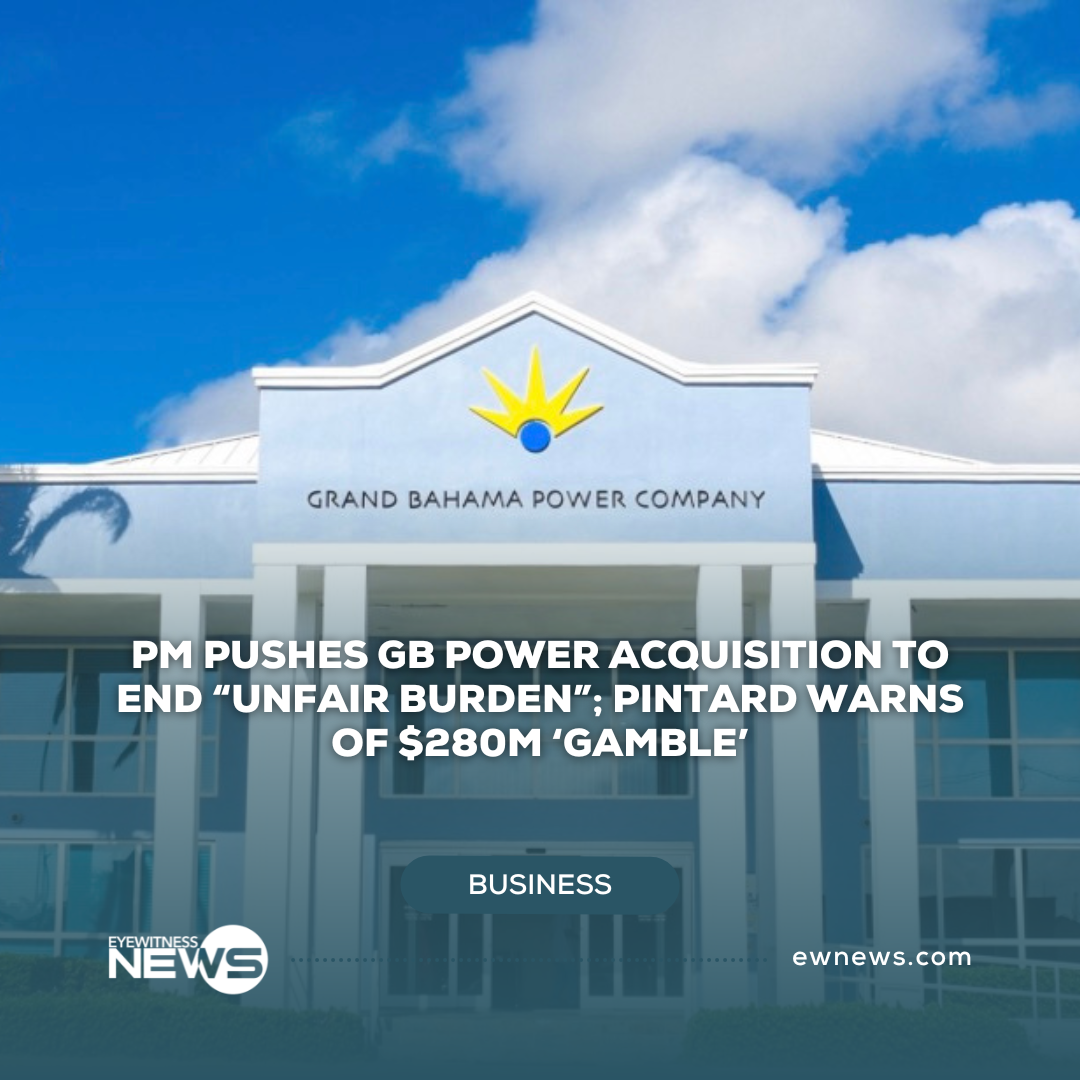
NASSAU, BAHAMAS – Prime Minister Philip Davis on Wednesday framed the government’s move to acquire Emera’s shares in Grand Bahama Power Company as a decisive step to correct what he called “an unfair burden” on Grand Bahama households and businesses. Speaking in Parliament during debate on the resolution, Davis said the acquisition is not just about ownership, but about fairness, competitiveness, and long-term development.
“Every month, Grand Bahama residents and businesses open their power bills and feel the weight of a system that has left them paying more than people in the rest of the country,” Davis said. He cited stark disparities in electricity costs, noting that households consuming between 351 and 800 kilowatt hours pay 11.95 cents per kilowatt hour in New Providence, compared with 22.87 cents in Grand Bahama. For usage above 800 kilowatt hours, the rates rise to 14.95 cents in New Providence and 27.31 cents in Grand Bahama. “A family in Grand Bahama can end up paying fifty to sixty dollars more per month in additional charges than a similar family in New Providence,” Davis said, before fuel and storm recovery costs are included.
The Prime Minister emphasized that the acquisition is part of a broader agenda to modernize energy across the country. “Energy is the foundation of growth. Jobs sit on energy. Housing sits on energy. Investment sits on energy. Tourism sits on energy. Manufacturing sits on energy. Small business sits on energy,” he said. “And when the cost of energy is too high, the cost of growth becomes too high. And growth becomes restricted.”
Davis said integrating Grand Bahama’s electricity system into the national grid will end the island’s over-reliance on expensive diesel and allow for the introduction of renewable energy, battery storage, and a regasification terminal. “We are building a future for Grand Bahama that includes renewables, battery storage, a regasification terminal,” he said. “We are ending Grand Bahama’s over-reliance on expensive diesel. We are giving the people of Grand Bahama a real chance.”
The Prime Minister stressed that Grand Bahama’s energy challenges are not hypothetical. “Some generators are aging and less efficient. Integrating renewable energy requires stronger lines, substations, and control systems. These are real issues. They do not disappear because somebody stands up and gives a political speech against action. They require planning. They require competence. They require financing. They require leadership. And over the past five years, this administration has shown that when it comes to energy reform, we are prepared to do that work.”
Davis framed the acquisition as a step toward national energy fairness. “We must choose whether Grand Bahama remains trapped in a costly arrangement that leaves Bahamian families and businesses paying more than their fellow citizens, or whether Grand Bahama moves into a fairer national energy future,” he said. He urged parliamentarians to consider whether policy should protect the status quo or address the burden Grand Bahama has carried for years.
The Prime Minister also contrasted his government’s approach with the Opposition. “Now, some ask whether Government should take on this responsibility. I welcome that question, because the record answers it,” Davis said. He pointed to ongoing grid modernization across the country, integration of solar and storage, improved resilience, and efficiency measures already underway in New Providence and other islands. “The material before us shows clearly that Grand Bahama can benefit from that experience in resilience, reliability, fuel diversification, efficiency, affordability, and long-term planning,” he said.
Davis dismissed criticisms from the Opposition as “defending the burden and echoing the status quo,” saying their warnings ignore the government’s five years of reforms. “We have chosen again and again to reject the status quo and choose progress instead. Every hard choice we made over these past five years has brought us to this moment,” he said. “We stabilized the country to get here. We rebuilt confidence to get here. We advanced energy reform to get here. We proved that Bahamians can finance and support major reform to get here.”
He warned that inaction would continue to disadvantage Grand Bahama businesses. “Does he believe it is fair? Does he believe it is right for the people of Grand Bahama to keep paying more for a basic service? Does he believe businesses in Grand Bahama should continue operating at a disadvantage because their electricity costs begin higher and rise faster?” Davis asked, urging parliamentarians to side with the people of Grand Bahama rather than the status quo.
The acquisition, Davis said, will provide residents and businesses with “a fairer national energy future” while enabling long-term investment in renewables, storage, and infrastructure. “Because one country should have one coherent energy direction. Because national development makes no sense while one major island remains boxed into a separate and more expensive structure,” he said.
The Prime Minister concluded by framing the move as part of a broader government vision for economic growth and national reform. “We are expanding opportunities across the archipelago. Energy reform in Grand Bahama and nationwide is part of the larger plan in motion. We choose Grand Bahama over the status quo,” he said, calling the resolution “progress in energy, housing, and health reform.”
The Davis administration has already tabled borrowing resolutions totaling $280 million to support the Grand Bahama Power acquisition, underscoring the scale of the financial commitment tied to the plan. However, the move has also drawn some skepticism, particularly given the government’s track record with state-owned utilities and longstanding operational and reliability challenges at Bahamas Power and Light (BPL), which critics argue raise questions about execution and long-term efficiency.
Opposition Leader Michael Pintard blasted the proposed $280 million government-backed acquisition of the Grand Bahama Power Company, warning that “the Government gambles with the country’s finances, and the Bahamian people pay if it goes wrong,” as he argued that Parliament is being asked to approve the deal “without a valuation, without a tariff model, and without a credible plan—on the basis of assertions, not analysis.”