


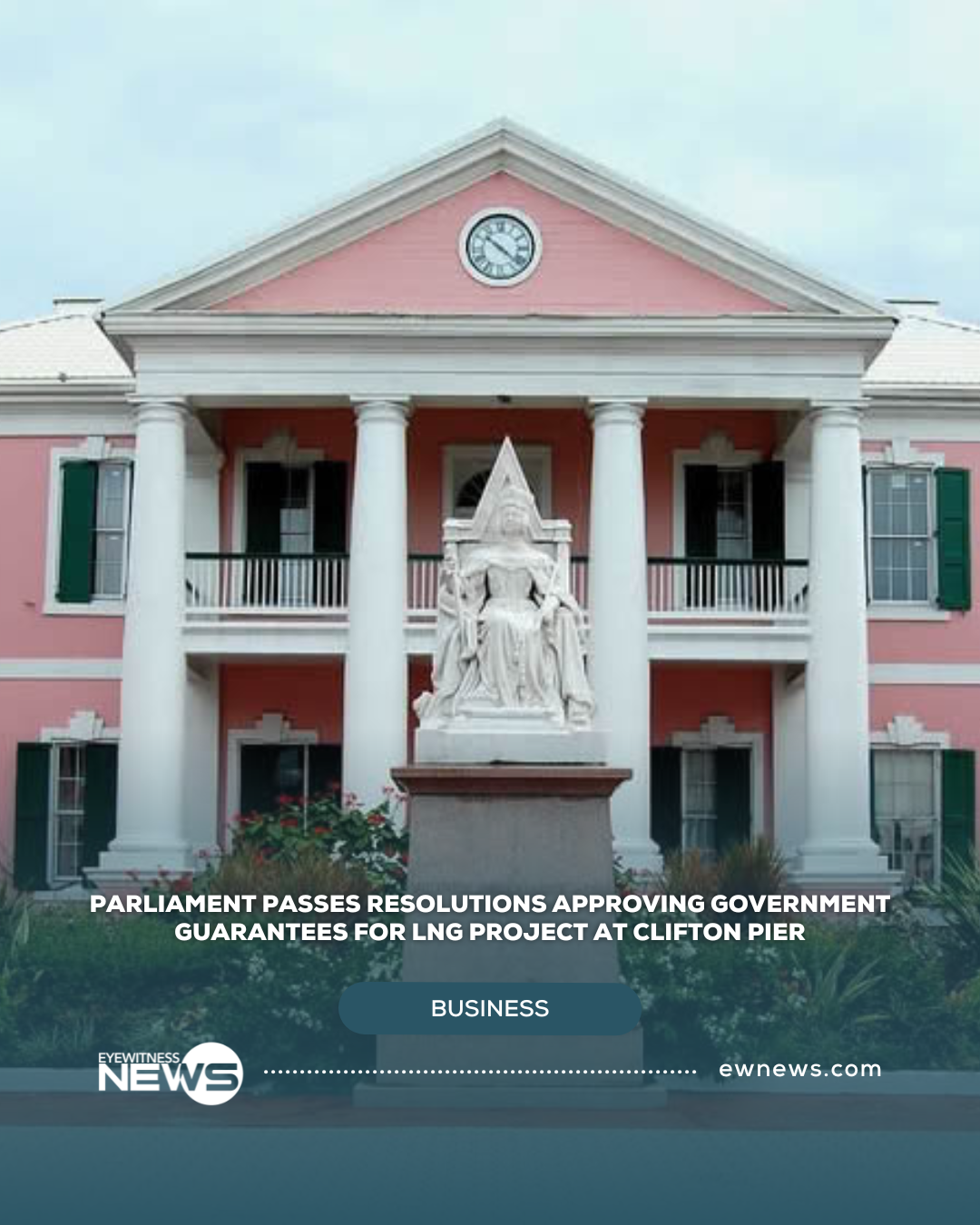
NASSAU, BAHAMAS — Parliament approved a series of resolutions authorising government guarantees tied to the Clifton Pier liquefied natural gas (LNG) project.
The resolutions include approval for a $30 million performance letter of credit to support fuel supply obligations under the LNG Sale and Purchase Agreement with Shell NA LNG LLC, a separate $30 million performance letter of creditlinked to the Terminal Development and Use Agreement for the development and operation of the LNG regasification terminal, and a $99.9 million revolving line of credit to finance LNG fuel purchases.
The guarantees involve Bahamas LNG Partner Ltd., a special purpose vehicle wholly owned by the Government, and Banco Santander S.A., and were brought to Parliament in accordance with Section 43 of the Public Debt Management Act, which requires House approval for any government-backed financial liability.
During debate, Opposition Leader Michael Pintard said the Opposition supports energy reform, diversification, and the inclusion of LNG in the national energy mix, but added that his party could not back the resolutions as presented.
Minister of Energy and Transport JoBeth Coleby-Davis said the resolutions provide the legal and financial framework necessary to advance the country’s transition to natural gas and secure reliable fuel supply for electricity generation.
“These resolutions are not isolated financial instruments,” Coleby-Davis told Parliament. “They are essential enablers of a comprehensive, technically sound, and internationally validated transformation of The Bahamas’ energy sector—commonly referred to as the New Energy Era.”
She said the approvals underpin long-term restructuring rather than short-term transactions, supporting fuel security, operational stability, and cost control across the power sector.
Coleby-Davis sharply criticised previous fuel hedging strategies, arguing they failed not because hedging itself was flawed, but because Bahamas Power and Light (BPL) lacked the technical capacity to burn the fuel being hedged.
“In simple terms,” she said, “the previous administration tried to buy insurance before fixing the engine.”
She detailed longstanding mechanical failures at Station A, including boiler instability, cooling system constraints, and auxiliary system failures, which forced BPL to rely on more expensive diesel instead of heavy fuel oil. As a result, she said, fuel hedges priced “on paper” could not deliver savings in practice, while artificially suppressed fuel rates created significant under-recovery.
“Protection became exposure,” Coleby-Davis said, adding that hedge premiums were absorbed into customer fuel charges while costs were deferred, ultimately leaving the utility with substantial liabilities to fuel suppliers.
By contrast, she said the current administration reversed that sequence by restoring operational readiness before executing fuel hedges on materially improved commercial terms.
“This is disciplined governance: fix the plant first, hedge second—and negotiate from strength, not vulnerability,” she said.
Coleby-Davis also pointed to operational and financial improvements at BPL, including reduced outage frequency and duration, faster restoration times, and lower system costs. She said investments in equipment and the physical plant have reduced operating expenses and allowed the government to roll back costly rental generation, delivering approximately $1.5 million in annual savings, with further reductions anticipated.
At the consumer level, she cited continued benefits under the Equity Rate Adjustment (ERA) programme, noting that thousands of residential customers paid lower electricity bills in 2025 compared with pre-ERA tariffs. Combined with the transition to LNG, she estimated consumer savings exceeding $100 million annually.
“These are not abstract policy outcomes,” she said. “They are tangible economic relief.”
Coleby-Davis said the energy reform programme has received international validation, noting that Moody’s Investors Service upgraded The Bahamas’ credit outlook to Positive, citing energy sector reform as a contributing factor. She added that the International Monetary Fund and the Inter-American Development Bank have also linked electricity reform to improved growth prospects and fiscal sustainability.
She confirmed that construction and early works at the LNG regasification terminal at Clifton Pier are advancing, with excavation and site preparation underway and Bahamian engineers and construction crews actively engaged.
“For the first time, LNG will be available in New Providence,” Coleby-Davis said, describing the project as a historic milestone that strengthens national energy security while supporting cleaner and more reliable power generation.
As debate concluded, she said the resolutions formalise “controlled and managed risk aligned with operational readiness,” and are already delivering measurable benefits to the Bahamian people.
“These resolutions represent discipline replacing volatility, infrastructure replacing fragility, and confidence replacing uncertainty,” she said.