


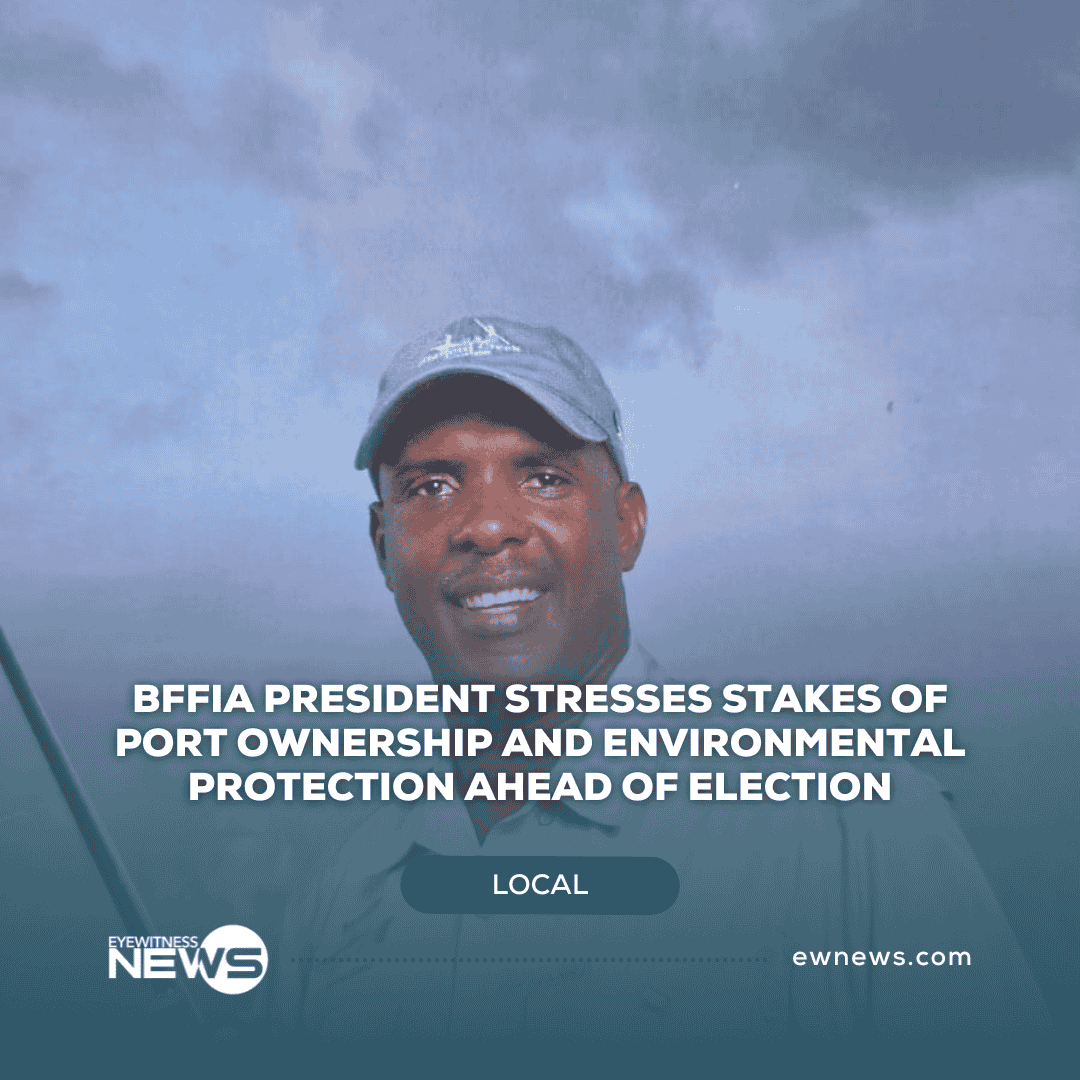
NASSAU, BAHAMAS- Bahamas Fly Fishing Industry Association President Bahamas Fly Fishing Industry Association and industry advocate Prescott Smith is warning that control of key national infrastructure and natural resources could shape the country’s economic future for generations, as he calls on Bahamians to consider what is at stake in the May 12 general election.
In a statement, Smith framed his comments as non-partisan, drawing on what he described as decades of experience working across multiple administrations and engaging directly with government on policy matters affecting tourism, fisheries and national development.
“I’ve been to the Cabinet of the Bahamas three times and only presented to the government things that would make life better for all Bahamians, not along partisan political lines,” he said.
Smith said his focus is not electoral politics but what he believes are structural economic issues tied to ownership and control of national assets.
“I wish to speak to you about what is at stake on May the 12th that will affect not only current but future generations,” he said.
A central theme of his address is the role of port infrastructure in shaping the Bahamian economy. Smith argued that control of shipping and logistics systems effectively determines control over national trade flows and distribution networks.
“He who controls your port controls your economy,” he said.
He pointed to the evolution of shipping operations in New Providence, specifically the consolidation of multiple entry points into a centralized system at Arawak Cay. According to Smith, this shift reduced what was once a distributed port system into a single dominant hub for both international imports and domestic redistribution.
“There were five locations where goods came in internationally by boat,” he said. “It went from five different locations to a single monopoly.”
Smith argued that this centralization has had lasting effects on pricing, distribution and access to goods across the Family Islands, which depend heavily on shipments routed through New Providence.
“They said that you cannot build another port within 22 miles of Arawak Cay,” he said. “So, you cannot break the economy, the goods and services are fed to the family islands from that location.”
A major focus of Smith’s remarks was the strategic importance of Morgan’s Bluff Port in North Andros, which he described as a potential alternative hub that could decentralize national logistics and expand economic opportunity.
“If all the goods are coming in by ship through Arawak Cay, and all of the goods leaving to go to the family islands are leaving Potter’s Cay, one is international shipping, the other one is domestic shipping,” he said. “Morgan’s Bluff is the geographical location that can break those monopolies and create new opportunities for Bahamians.”
Smith said the control of Morgan’s Bluff is central to the broader question of national ownership.
“He who controls Morgan’s Bluff Port will end up controlling the entire country,” he said.
He also linked the issue to past and present administrations, including former Prime Ministers Perry Christie, Hubert Ingraham, Hubert Minnis, and current Prime Minister Philip Davis, stating that each has faced pressure regarding port development and industrial proposals.
Smith said that while governments have differed in approach, the underlying tension between national control and private economic influence remains constant.
“You can always look for negatives from each administration,” he said. “But you also have to see the positive. Some leaders did not give into proposals that would have transferred control of key national assets.”
He specifically referenced North Andros as a focal point of competing development interests, including proposals he said would have involved large-scale industrial activity tied to limestone extraction and port development.
Smith warned that such projects could impact freshwater systems, mangrove ecosystems and agricultural land, all of which he said are critical to both environmental sustainability and economic resilience.
“Morgan’s Bluff is located on Andros Island. It’s the island that has over 40 percent of the land for the entire Bahamas,” he said. “It’s home to the largest pine forest in the Bahamas, the largest freshwater resources of the country, the largest amount of arable land in the Bahamas.”
He added that Andros also plays a critical role in supporting marine biodiversity and commercial fishing across the Great Bahama Bank.
“The Bahamas is 85% marine environment,” he said. “This means most of the wealth in the country is in that space.”
Smith said any disruption to freshwater systems or coastal ecosystems could have long-term implications for food security, fishing livelihoods and tourism.
“This means that all those commercial fishermen—from Spanish Wells to Long Island to Abaco—who depend on the Great Bahama Bank are directly tied to this issue,” he said.
Beyond ports and land development, Smith also spoke extensively about the marine tourism and fishing industry, where he has played a long-standing leadership role. As president of the Bahamas Fly Fishing Industry Association, he said the country holds one of the most valuable sport fishing ecosystems in the world.
“The Bahamas is home to the largest flats and the bonefish population in the world,” he said.
He also referenced broader ecological assets, including coral reef systems, blue holes, seagrass beds and marine nurseries, which he said position the Bahamas as a global leader in marine biodiversity.
Smith credited earlier government efforts to formalize and regulate the fishing industry, particularly legislation passed in 2016 that established clearer structures for Bahamian participation in guiding and sport fishing.
He acknowledged former Minister Alfred Gray for supporting reforms that strengthened local ownership in the industry, and also referenced early institutional development efforts led by former Minister Pierre Dupuch.
Smith said those reforms helped transition the industry from informal participation to structured economic activity with clearer legal protections for Bahamians.
However, he warned that the sector remains vulnerable if ownership protections are weakened or reversed over time.
Smith also linked marine resource governance to broader institutional development, referencing the establishment of the Ministry of Natural Resources, which he said marked an important step in managing land, water and marine ecosystems more effectively.
He credited former Minister Vaughn Miller and Reese Chipman for their roles in supporting that institutional framework.
Smith concluded his address by urging Bahamians to think beyond political cycles and focus instead on long-term economic sovereignty and ownership of national assets.
“I hope that when you go to vote, you truly think about what is at stake,” he said.
He argued that the central question facing the country is whether Bahamians will remain true owners of their resources or become participants in systems controlled elsewhere.
“This is what is on the ballot on May the 12th,” he said.