


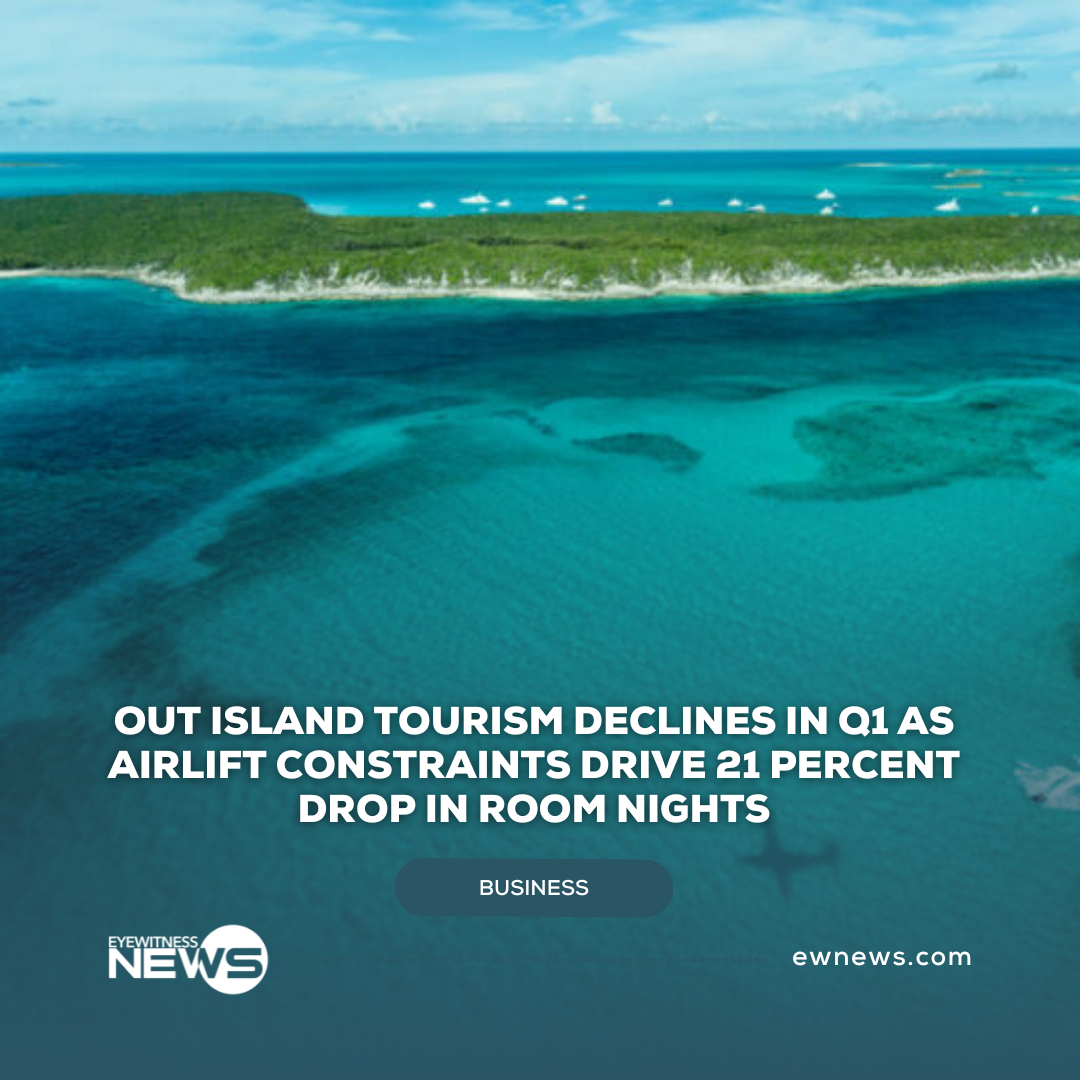
NASSAU, Bahamas — Tourism across The Bahamas’ out islands saw a notable contraction during the first quarter of the year, with room nights sold falling by 21 percent and room revenue declining by approximately 11 percent according to Kerry Fountain, Executive Director of the Out Island Promotion Board.
While speaking on the performance of BOIPB member hotels during The Bahamas Hotel and Tourism Association’s (BHTA) Board of Director’s meeting, Fountain noted that the decline which he described as both structural and cyclical, is being driven primarily by reduced airlift capacity, shifting global travel patterns, and lingering disruptions in airline connectivity to several Family Island destinations.
“Room nights sold for my member hotels are down about 21 percent, and the room revenue is down about maybe 11 percent” Fountain said, underscoring the scale of the contraction across the sector.
He added that while demand signals remain visible in marketing data, the ability to convert interest into arrivals is being constrained by reduced seat capacity and uneven route performance across key markets.
A central factor behind the downturn, Fountain said, is the collapse of Silver Airways, which significantly reduced available seats into the Out Islands and triggered a ripple effect across hotel bookings.
“There’s a correlation definitely between room nights sold and airline seats delivered. The Florida-based airline ceased operations in June 2025 after filing for bankruptcy, with Fountain noted that the visitor arrival numbers to the out islands began to decline around that time.
Fountain noted that a deeper review of island-by-island performance confirmed the same pattern: where seat capacity declined, hotel performance followed.
While some destinations such as Eleuthera, Exuma and Cat Island have shown relative resilience, he noted that overall performance across the Out Islands remains negative, with several islands experiencing sustained pressure in both occupancy and revenue.
Using Abaco as an example Fountain noted; “In 2024, we had 37,761 seats available. Last year we had 23,672 seats available. That was a 37.3 percent drop.”
Fountain said the decline in available seats has had a direct impact on arrivals and hotel occupancy levels, with fewer passengers converting into visitors even when seats are available.
“Look at the Marsh Harbour, Fort Lauderdale route. In 2024, we had 20,814 passengers that actually traveled on those 37,761 seats. If you look at 2025 it was 12,961.”
He added that the issue is not just capacity reduction, but also weakening load factors.
“What is more disturbing to me is we’re not only seeing the number of seats drop, but the rate of passengers traveling is also falling faster than expected.”
Fountain also pointed to long-term structural weaknesses in Out Island hotel performance, including historically low occupancy rates.
“When I looked in 2024, when we had the most seats going to the Outer Islands compared to over the last maybe 10 years, the average occupancy was still only 36.7 percent for all Out Island hotels.”
Despite declining arrivals, he said marketing indicators show strong growth in interest and engagement.
“Our website traffic January through March is up 162 percent, and hotel leads are up 222 percent. So the advertising is working.”
However, he said the challenge lies in converting that interest into bookings and sustained travel demand.
Fountain also raised concerns about the growing influence of second-home rentals and alternative accommodation platforms, which he said are reshaping traditional hotel demand.
In response to declining performance, the Out Island Promotion Board has introduced a series of targeted incentives designed to stimulate short-term demand and improve affordability.
“We reintroduced our $250 air credit, which provides an air credit of $250 for four-night stays.”
Additional incentives include “fly-free” offers tied to stay duration.
“You stay four nights, you get one ticket from Nassau to one of our islands. If you stay seven nights, we pay for two tickets.”
The program has also been extended internationally.
“We have extended that now, just not to U.S. and Canada residents, but also residents of Europe and Latin America.”
Fountain also highlighted efforts to include residents within The Bahamas, particularly those in New Providence.
“We haven’t left out our Bahamas residents, particularly those that reside in or on the island of New Providence. As long as you’re living legally in the Bahamas, this offer is open to you.”
Looking ahead, he pointed to the rapid expansion of cruise capacity as both an opportunity and a competitive challenge. Fountain noted that the shift in cruise deployment toward the Caribbean could benefit The Bahamas, but also increase competition and pressure pricing across the tourism sector.
“A lot of the cruise lines are going to be now moving or deploying from the Middle East area, from the Mediterranean area, to the Caribbean, and more specifically, to the Bahamas.”
“With more supply, prices will drop, and there are going to be more all-inclusive, value-added options to get to the Bahamas,” he noted.