


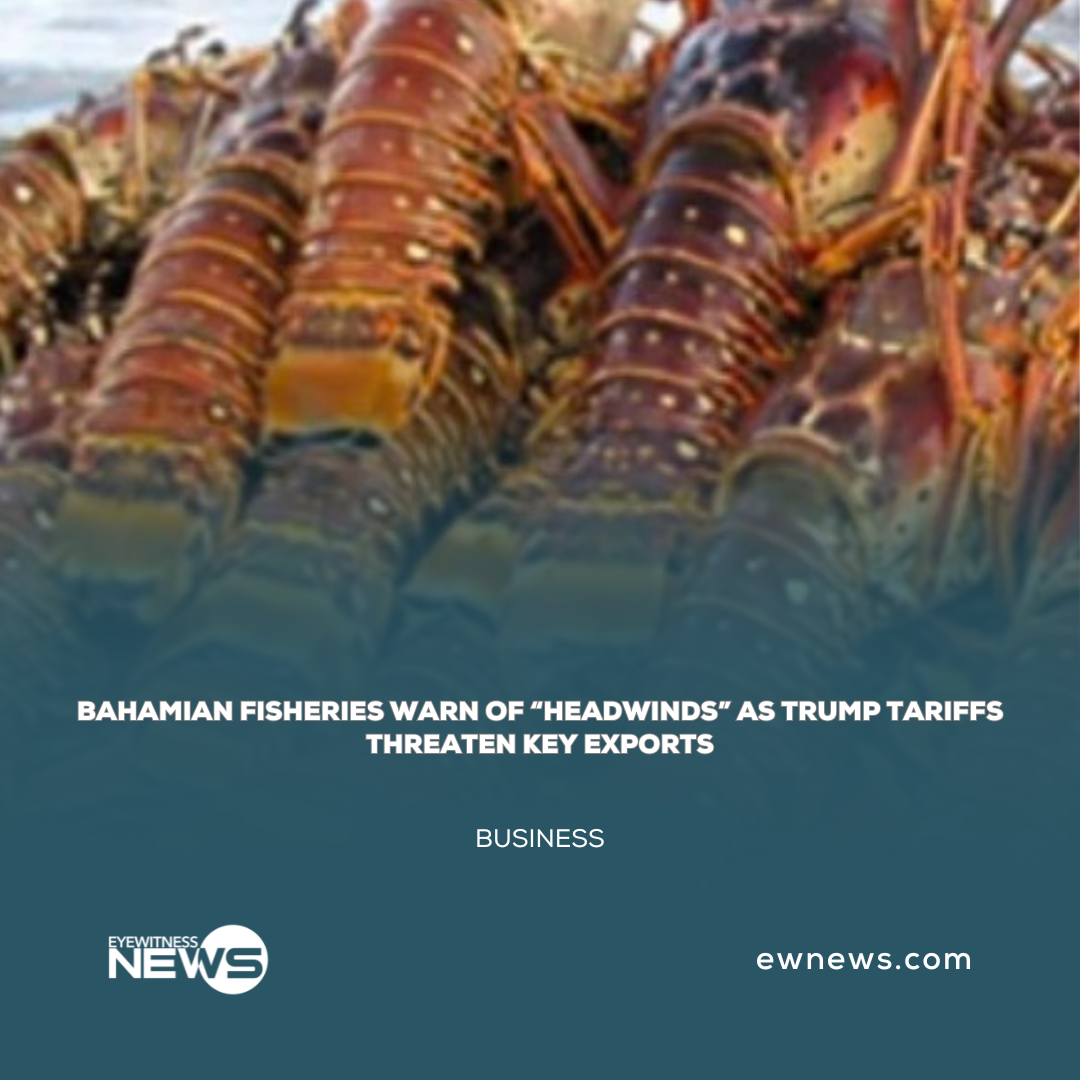
NASSAU, BAHAMAS — The country’s commercial fishing industry is bracing for potential economic fallout after U.S. President Donald Trump announced plans to raise global tariffs to 15 percent, with industry leaders warning the move could squeeze one of The Bahamas’ most vital export sectors just as a new season approaches.
Adrian LaRoda, president of the Bahamas Commercial Fisheries Alliance, said the tariff hike poses serious uncertainty for fisheries, which rely heavily on advance pricing agreements with U.S. wholesalers.
“It is concerning,” LaRoda said in an interview. “We don’t export a lot overall as a country, but fisheries is a big deal. Our wholesalers hedge their quantities and prices with us ahead of the crawfish season, so we know what we have to harvest. If these tariffs are still in place going into the next season, there’s nothing we can do about it — and that could hurt.”
Trump’s latest move comes after the US Supreme Court ruled 6–3 that his earlier sweeping tariffs exceeded presidential authority under emergency powers. Within days, Trump issued a new order imposing a 10 percent duty under separate trade law authority, then announced an increase to 15 percent, blasting the court’s decision on Truth Social as “anti-American.”
The tariffs are scheduled to last 150 days unless extended by Congress.
LaRoda warned that the biggest danger is not just the tariff itself but how U.S. buyers respond.
“We’re hoping the U.S. market will absorb the tariffs and the price hikes,” he said. “It would really hurt us if wholesalers come back and say we have to split the cost or reduce our export price to compensate. That would be a big hit for us as an economy.”
He noted that the industry is only now emerging from a difficult season marked by weak prices.
“We saw low prices going into the last season and it didn’t get much better by the end. We were close to break-even. If we have to absorb lower prices again because of tariffs, it could be painful.”
LaRoda also expressed skepticism that the policy will be short-lived.
“Like many economists, we don’t see Trump changing his mind,” he said. “Even if Congress blocks one measure, he could come back with another tariff — and it could be more. No matter which way it goes, we’re going to face some headwinds.”
He added that small island economies dependent on limited exports could be disproportionately affected.
“We just hope there is some consideration for small island states like The Bahamas, where fisheries may be one of the only major exports. We would like to see no tariffs on our exports, but we just hope it doesn’t get any worse.”
While The Bahamas is not a major goods exporter overall, fisheries products — particularly seafood — represent a crucial revenue stream and source of employment in Family Islands.
Data from the Bahamas National Statistical Institute show exports to the United States reached over $110 million in the third quarter of 2025, accounting for the majority of the country’s foreign goods sales.