


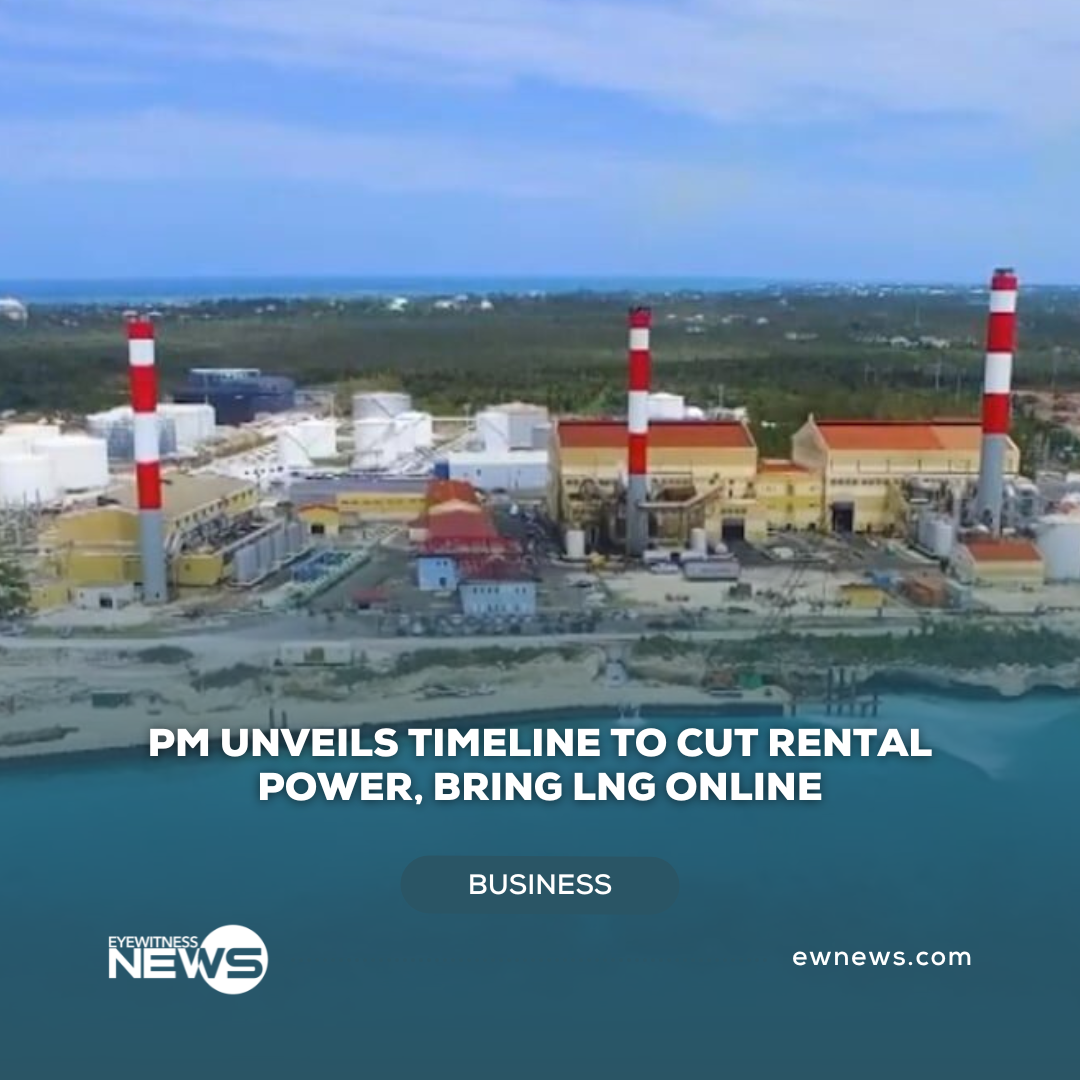
NASSAU, BAHAMAS: Prime Minister Philip Davis says The Bahamas will begin introducing liquefied natural gas (LNG) this year and start phasing out 40 megawatts of costly rental generation in January, as the Government pushes ahead with a major overhaul of an electricity system he said requires hundreds of millions of dollars in investment.
During a national address Monday night, Davis outlined a series of deadlines for the country’s energy transformation, including the return of generation units over the coming months, the phase-out of 40 megawatts of rented generation beginning in January, new LNG infrastructure and the commissioning of combined-cycle plants at Blue Hills during 2027 and 2028.
“We will be able to produce power at a fraction of today’s fuel cost,” Davis said.
The Prime Minister framed the energy overhaul as an economic imperative, arguing that reliable and lower-cost electricity is essential to supporting business growth and the country’s wider development.
“We achieved political Independence more than fifty years ago. Now energy security must become part of our economic independence,” Davis said.
He said the scale of the challenge is significant, noting that Bahamas Power and Light (BPL) was carrying more than $500 million in debt and another $100 million in unfunded pension obligations.
Engineers, he said, had also identified $500 million in critical upgrades needed to prevent a complete failure of the country’s electrical infrastructure.
More than 60 percent of New Providence’s generation equipment required replacement, according to Davis, while that figure stood at 80 percent in the Family Islands.
The country has also been spending more than $40 million annually renting engines to maintain generation capacity.
“Money out the door, and not one dollar of it buying an asset we would own at the end,” Davis said.
The Government is now seeking to shift away from that model.
Davis said Blue Hills GT2, which has been out of service since the spring, is returning, along with the battery storage system used to reduce evening peak demand.
Two Clifton Pier engines are scheduled to return before the end of September, while a Blue Hills turbine undergoing major inspection is expected back during the first quarter of next year.
“In January we begin phasing out forty megawatts of rented generation, because permanent capacity will have replaced it,” Davis said.
He stressed, however, that rental generation would only be phased out when replacement capacity has been tested and is ready.
The transition to LNG represents another major component of the Government’s strategy.
Davis said the first phase will come online this year and scale to 190 megawatts of gas-fired capacity by late 2027. New pipelines are also expected to replace infrastructure that is more than 40 years old.
Combined-cycle plants at Blue Hills are then expected to be commissioned during 2027 and 2028.
The Government has also moved to expand renewable generation, with 23 microgrid and solar projects under development across the Family Islands representing close to 200 megawatts of new generation.
Davis said Bahamian companies are partners on almost every project.
On New Providence’s transmission and distribution network, Davis said Bahamas Grid Company (BGC) has delivered a $130 million foundational upgrade that includes stronger steel poles, larger conductors, modern protection devices, fibre communications, a looped transmission system and three new high-voltage substations.
The three substations reached mechanical completion in July and have entered final testing and commissioning.
Davis said the work has contributed to a 45 percent reduction in outage frequency against historical averages and a 35 percent decline in outage duration.
However, he acknowledged that those improvements have not insulated the country from recent disruptions.
“The gains are real. But the outages Bahamians are experiencing now are also real,” Davis said.
The Prime Minister pointed specifically to the July 30 island-wide outage, which he said resulted from an underground cable fault that caused a transformer failure at the Blue Hills substation, rather than a shortage of generation.
The Government is now replacing substation equipment, switchgear and high-voltage assets that failed this summer instead of patching them, Davis said.
Remote monitoring is also expected to go live at Clifton Pier this year before being introduced at Blue Hills.
Davis also announced plans to review rules governing residential renewable-energy systems, potentially opening the door to easier access to rooftop solar.
In consultation with URCA, BPL, consumer groups and Bahamian solar installers, the Government will pursue simpler applications, predictable approval times, wider access to bi-directional meters and “appropriate credit” for excess electricity supplied by households to the grid.
Advanced metering will also be accelerated to give consumers greater visibility into their electricity consumption.
The Prime Minister also addressed BPL’s operating costs and internal controls, revealing that the utility spent approximately $20 million on overtime last year despite transmission and distribution responsibilities having shifted to BGC.
He said three employees in one department received more than $600,000 in overtime collectively during a single 12-month period.
“One record shows an individual claiming eighteen hours on Christmas Day, then twenty-four hours each of the next three days that followed,” Davis said.
“Ninety hours across four consecutive days.”
Davis said a new overtime policy is now in force, with planned overtime capped and additional scrutiny imposed when a technical worker’s overtime exceeds 30 percent of base salary.
Such cases will trigger a review by the division head and executive management team and be reported to BPL’s board, while repeat patterns will be flagged.
“Every dollar recovered from waste is a dollar available for a spare part, a repair crew, new equipment and training,” Davis said.
Despite the investment and new generation timetable, Davis cautioned that the transition will not immediately eliminate outages, with equipment failures and temporary disruptions still possible as old infrastructure is replaced.
But he said the ultimate objective is an electricity system capable of supporting a larger Bahamian economy with stable, reliable and less expensive power.
“This is the hardest infrastructure challenge our country has faced in fifty years of independence,” Davis said.
“We will finish what we started.”