


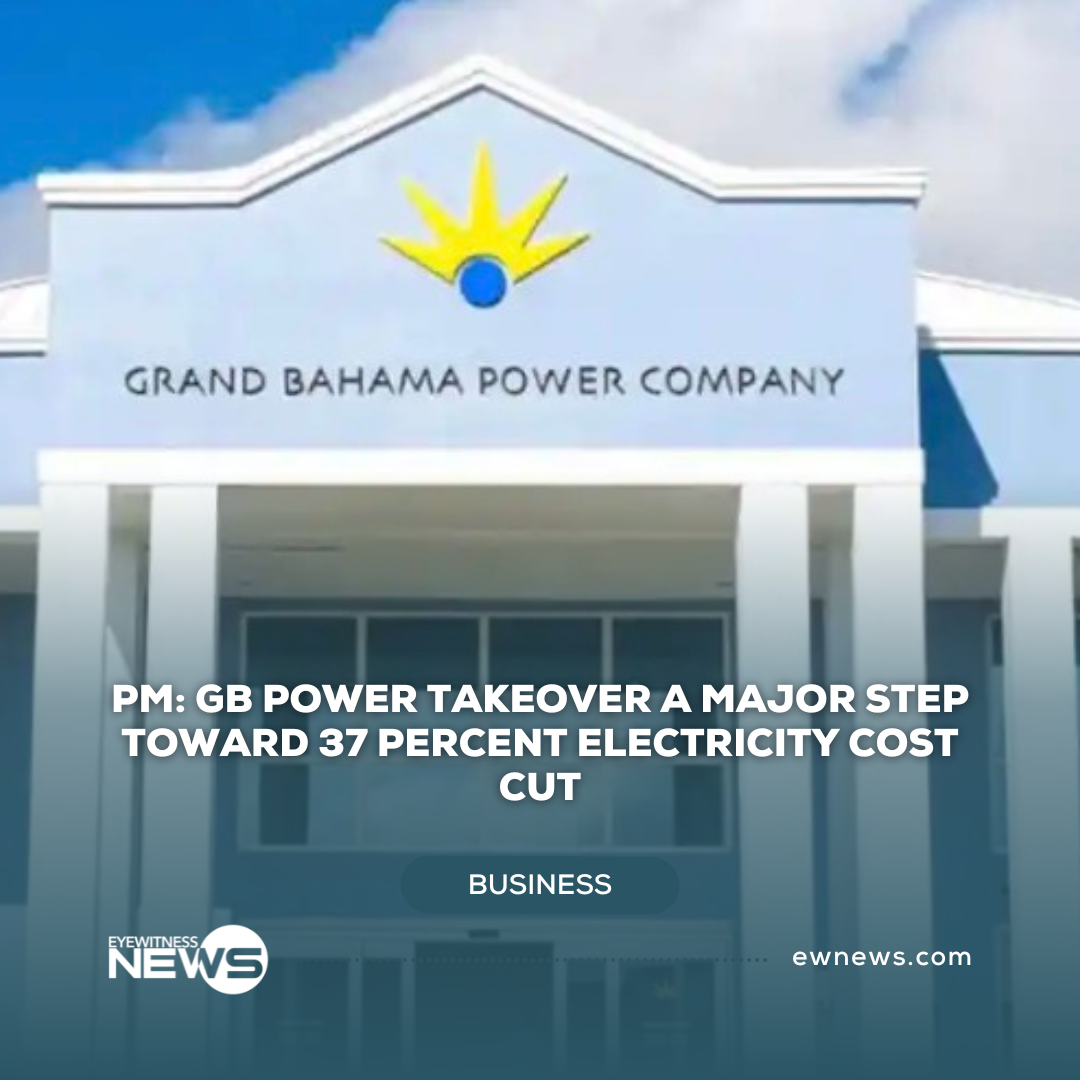
NASSAU, BAHAMAS- Prime Minister Philip Davis says the government’s acquisition of the Grand Bahama Power Company marks a major step toward reducing electricity costs by an average of 37 percent for households and businesses Grand Bahama, as part of a wider effort to lower the cost of living and modernize the national energy system.
The announcement on Grand Bahama follows a series of parliamentary approvals tabled earlier in March, when the Government moved to secure financing for the acquisition and associated infrastructure support. At that time, two resolutions were brought to the House of Assembly seeking approval for $280 million in government-backed borrowing tied to the deal.
Prime Minister Davis speaking at the acquisition announcement on Grand Bahama said the move is designed to directly address long-standing disparities in electricity pricing and improve economic competitiveness in Grand Bahama.
“This decision was made with a clear purpose, to bring down the cost of electricity for the people of Grand Bahama,” he said. “We are going to lower that burden and in doing so, give families room to breathe and to spend on other priorities.”
He added that the restructuring will have wide-ranging implications for households, businesses, and investors.
“Bahamians businesses will have an opportunity to plan and invest and compete on level ground,” Davis said. “Investors will understand that Grand Bahama has a more favorable investment climate.”
The Government of The Bahamas, through a special purpose vehicle called the Grand Bahama Electricity Company, is acquiring all outstanding shares of Grand Bahama Power Company. The transaction is funded by a loan from Standard Chartered and Scotiabank, guaranteed by the Government of The Bahamas.
Under the agreement, the government will acquire all outstanding shares of the Grand Bahama Power Company. Officials confirmed that existing employees will remain in place, and the current management team will continue operations throughout the transition.
“This acquisition also protects the employment and benefits of all existing employees of Grand Bahama Power Company,” Davis said. “The management team will remain in place.”
Grand Bahama Power Company Chief Operating Officer Nikita Mullings described the transition as a defining moment for the utility and its workforce.
“Today’s announcement is a big one for us here at Grand Bahama Power, but it does not change what defines us — our commitment to safety, reliability and service excellence.”
She emphasized that continuity of operations and service delivery remains central during the ownership transition. “It does not change our shared responsibility to our customers and this community,” she said.
Mullings also highlighted the role of employees in maintaining critical infrastructure across the island.
“These are the leaders who make sure that the systems and the people are in place, the tools available and the communication happens, and that every detail is looked after to ensure safe generation, transmission and distribution of electricity,” she said. She added that the company remains aligned with national energy reform.
“As we venture through this transition and beyond, we remain committed to ensuring and strengthening alignment with the national energy policy,” Mullings said. “I know that the Grand Bahama Power team will continue to deliver for our customers from the East End to the West End with the same pride and commitment.”
Karen Hutt, Emera’s Executive Vice President Corporate Development noted:
“This is an exciting time of transition for Emera, for the Grand Bahama Power Company and for Grand Bahama,” Hutt said. “This transition of ownership from Emera to the government provides a historic opportunity for Grand Bahama Power and the island of Grand Bahama to play a pivotal role in the nation’s energy future.”
She praised the workforce for maintaining service through hurricanes and operational challenges.
“The committed and skilled Grand Bahama Power team continue to deliver for customers across this beautiful island,” she said.
Energy Minister JoBeth Coleby-Davis said the reform directly addresses long-standing inequalities in electricity pricing between Grand Bahama and other islands.
“For too long, families and businesses have carried the weight of extremely high electricity costs,” she said. “Today marks the beginning of levelling the playing field for consumers, both residential and commercial.”
She provided examples showing significant price differences across the country, noting that harmonisation under national regulatory oversight is expected to deliver meaningful savings.
“These observations aren’t abstract. They are real,” she said. “In household budgets, every penny is important and every dollar counts.”
Officials said tariff alignment could reduce electricity bills by an average of 37 percent, depending on usage levels.
“This acquisition is not only about ownership,” Coleby-Davis said. “It is about fairness, accountability, and ensuring that the people and businesses of Grand Bahama benefit from the same modern regulatory protection as Bahamians elsewhere.”
She added that the reform builds on earlier national initiatives aimed at reducing electricity costs across the country.
“It is the same approach that we will implement in Grand Bahama,” she said.
Davis said the acquisition is part of a broader national energy transformation focused on affordability, reliability, and long-term economic growth.
“Energy is the sector that enables every other sector,” he said. “We are truly entering an exciting time for Grand Bahama’s progress and towards unleashing a complete economic rebirth.”
Officials said further details on tariff implementation and transition timelines will be released in the coming weeks.