


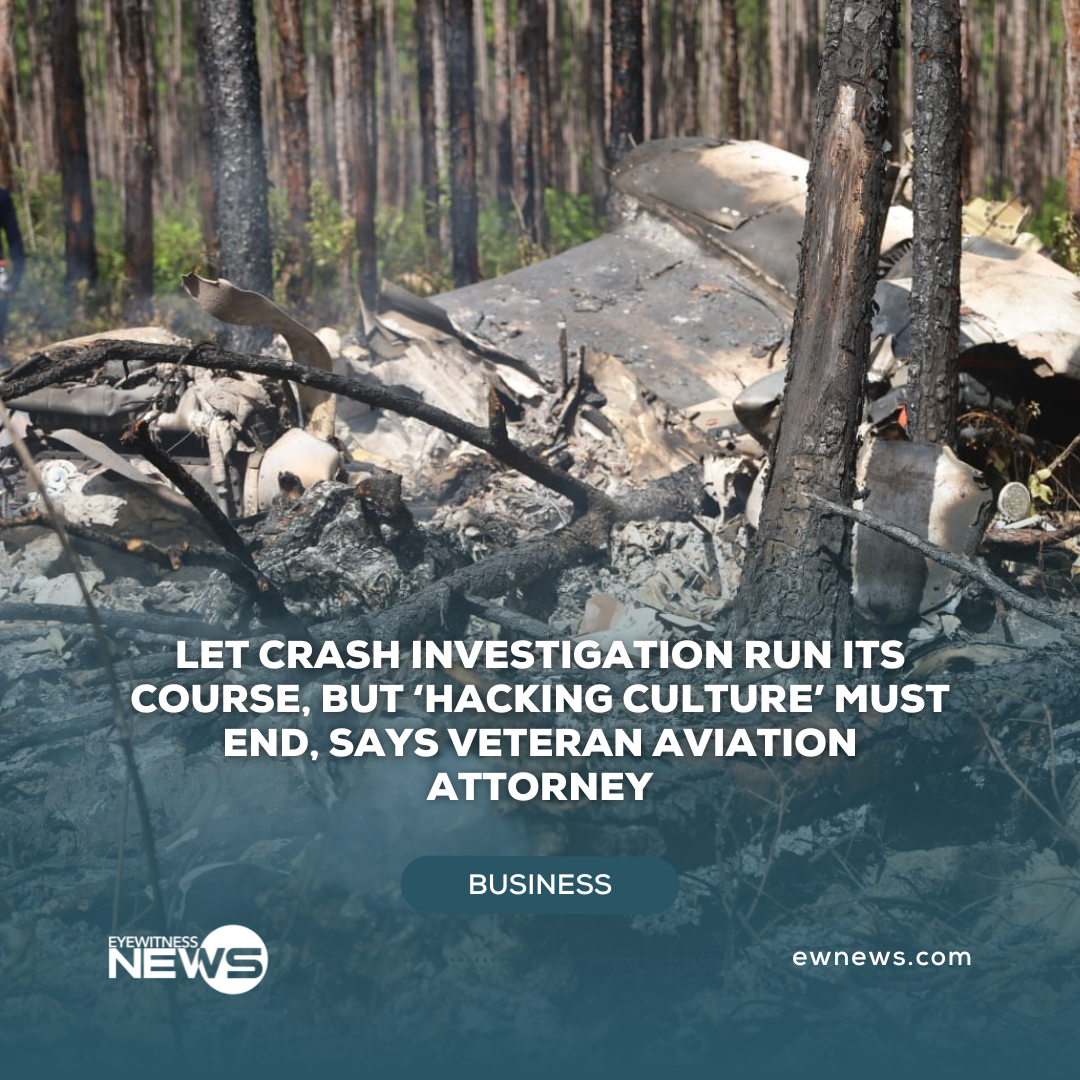
NASSAU, BAHAMAS: The country’s aviation industry must confront longstanding compliance issues while investigators work to determine what caused the deadly Flamingo Air crash, says veteran aviation attorney Llewellyn Boyer-Cartwright, who is calling for an end to what he describes as a “hacking culture” and stronger enforcement of existing regulations.
The Managing Partner of Harley James Law said The Bahamas already has the laws and regulatory framework needed to oversee civil aviation, but the challenge remains ensuring those rules are properly enforced.
“There exists the statute law and regulations that maintain the infrastructure of civil aviation, which covers any aircraft, whether commercial, charter or private,” Boyer-Cartwright said. “Really, what it boils down to is enforcement.”
He said the Civil Aviation Authority serves as the industry’s gatekeeper and has the responsibility of ensuring operators meet the required standards.
Boyer-Cartwright, who has been involved in aviation since 1983, said concerns surrounding unlicensed operators have existed for decades, although he acknowledged improvements have been made within the sector.
“This problem has existed and still exists today, to a lesser degree because of advancements we have made in the civil aviation sector.”
His comments come as the Air Accident Investigation Authority continues its probe into the July 10 Flamingo Air crash, which claimed 10 lives.
Boyer-Cartwright said the public must allow investigators to complete their work before conclusions are drawn.
“For me, there are too many unknowns. What caused it, we don’t know yet. Let the Air Accident Investigation Authority do their job.”
However, he noted that the tragedy has spot a spotlight on issues within the local aviation sector.
He warned that many travelers focus on finding transportation to the Family Islands without verifying whether the operator is authorized to provide commercial services.
“It doesn’t matter only if the pilot is qualified or the aircraft is airworthy. The question is whether it is a licensed operator.”
Boyer-Cartwright explained that obtaining an Air Operator Certificate and an Air Transport Licence requires operators to meet strict regulatory requirements before approval is granted.
He also renewed calls to eliminate what he described as a “hacking culture” in aviation.
“It needs to be eradicated,” he said. “Aviation is a highly regulated industry for obvious reasons. It has to stop. It has to come to an end.”
Boyer-Cartwright said while smaller operators may face challenges in meeting regulatory requirements, compliance cannot be compromised when passenger safety is involved.
“This is nothing personal against these operators. I understand that everyone is doing their best to make a living, but an airplane is not a taxi. It is more than that.”
On possible legal consequences from the crash, he said it is too early to determine where liability may fall.
“Wherever liability falls, the Air Accident Investigation Authority will determine what penalties, if any, will ensue.”
He added that The Bahamas, as a member of the International Civil Aviation Organization, must continue upholding international aviation standards and protecting passenger rights.
“At the end of the day, it comes down to responsibility, but right now there are too many unknowns. We need to allow the investigation to run its course.”