


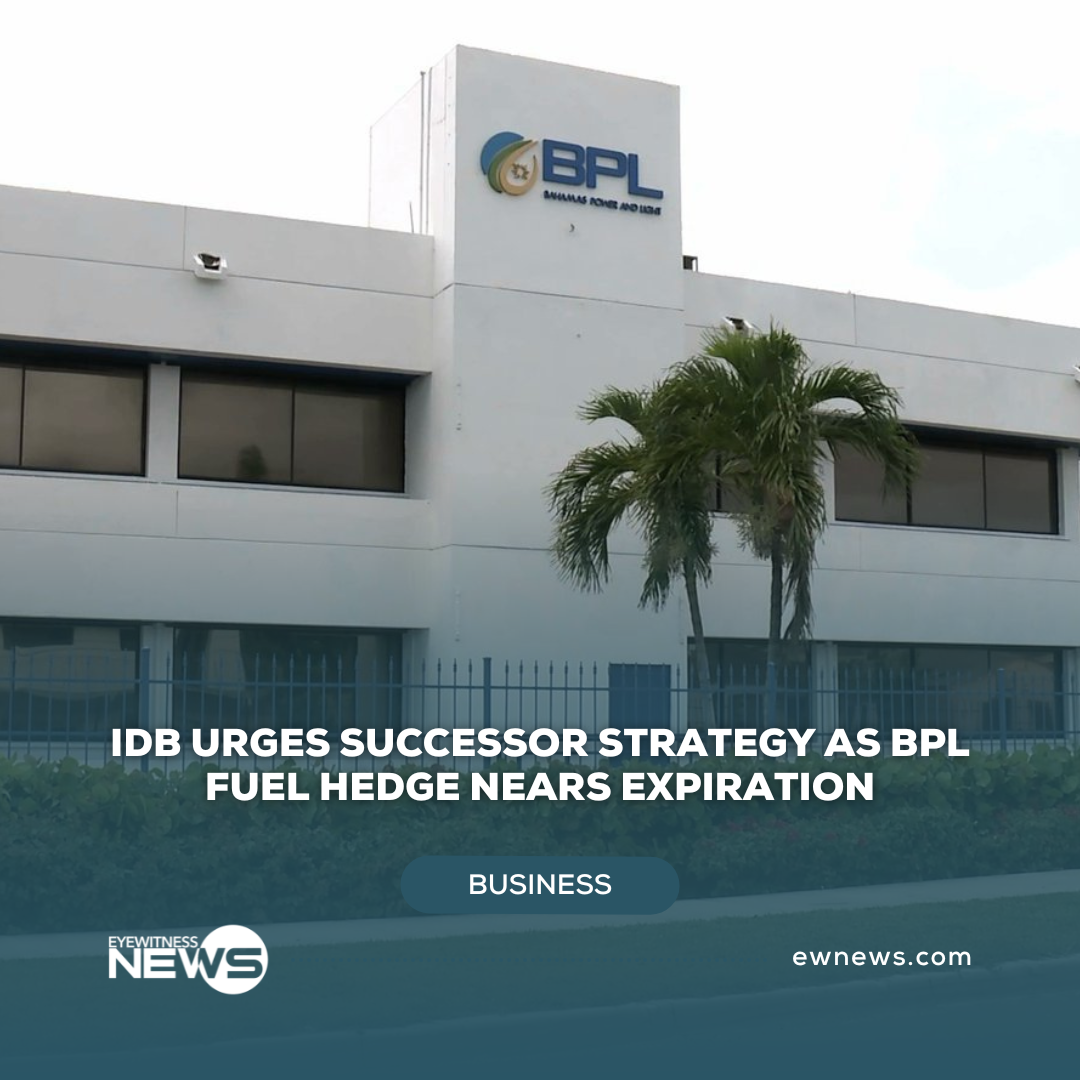
NASSAU, BAHAMAS:The government’s strategy of insulating consumers from volatile global oil prices through Bahamas Power and Light’s (BPL) fuel hedge has helped preserve household purchasing power, but the programme’s December 2026 expiry presents the country’s greatest medium-term economic risk unless a replacement strategy is implemented, according to the Inter-American Development Bank (IDB).
In its recently published Caribbean Economics Quarterly Bulletin for August 2026, the IDB said the fuel hedging programme has shielded the domestic economy from the recent energy shock by helping to keep electricity costs in check despite geopolitical uncertainty and elevated global oil prices.
However, the multilateral lender cautioned that the hedge provides electricity price protection only through the end of calendar year 2026.
“If Brent crude oil prices remain above US$65, the full cost adjustment will hit in 2027 unless the hedge is renewed and widened,” the report stated.
The IDB warned that allowing the hedge to expire without a successor strategy “represents the most significant medium-term risk” to The Bahamas, citing the potential fiscal implications as well as the impact on the country’s tourism competitiveness.
Despite that warning, the report said The Bahamas has so far weathered geopolitical uncertainty from a position of improved macroeconomic and institutional strength.
It noted that the government has completed a sustained post-COVID fiscal consolidation, achieving a primary surplus of 3.7 percent of gross domestic product (GDP) in fiscal year 2024/2025 compared with 0.1 percent in fiscal year 2022/2023, while recording an overall fiscal deficit of just 0.5 percent of GDP — the smallest in 25 years.
The IDB also said the Bahamian economy expanded by an estimated 3.8 percent in 2025, marking its fourth consecutive year of above-trend growth and outperforming the International Monetary Fund’s (IMF) earlier forecast of 2.8 percent.
According to the report, economic growth was driven primarily by strong construction activity and continued momentum in the cruise tourism sector.
The bank added that while growth is expected to moderate toward its long-term trend, The Bahamas’ medium-term outlook remains stronger than its pre-pandemic average growth rate of one percent and compares favourably with many regional peers, reflecting what it described as the country’s structural resilience and effective policy buffers.
The report also highlighted the role of the BPL fuel hedge in containing inflation, noting that while consumer prices rose 3.1 percent year-over-year in March 2026, higher energy costs were partially offset by the hedging programme. The IMF is forecasting inflation to ease to 1.8 percent in 2026, well below the Latin American and Caribbean regional average of 6.6 percent.