


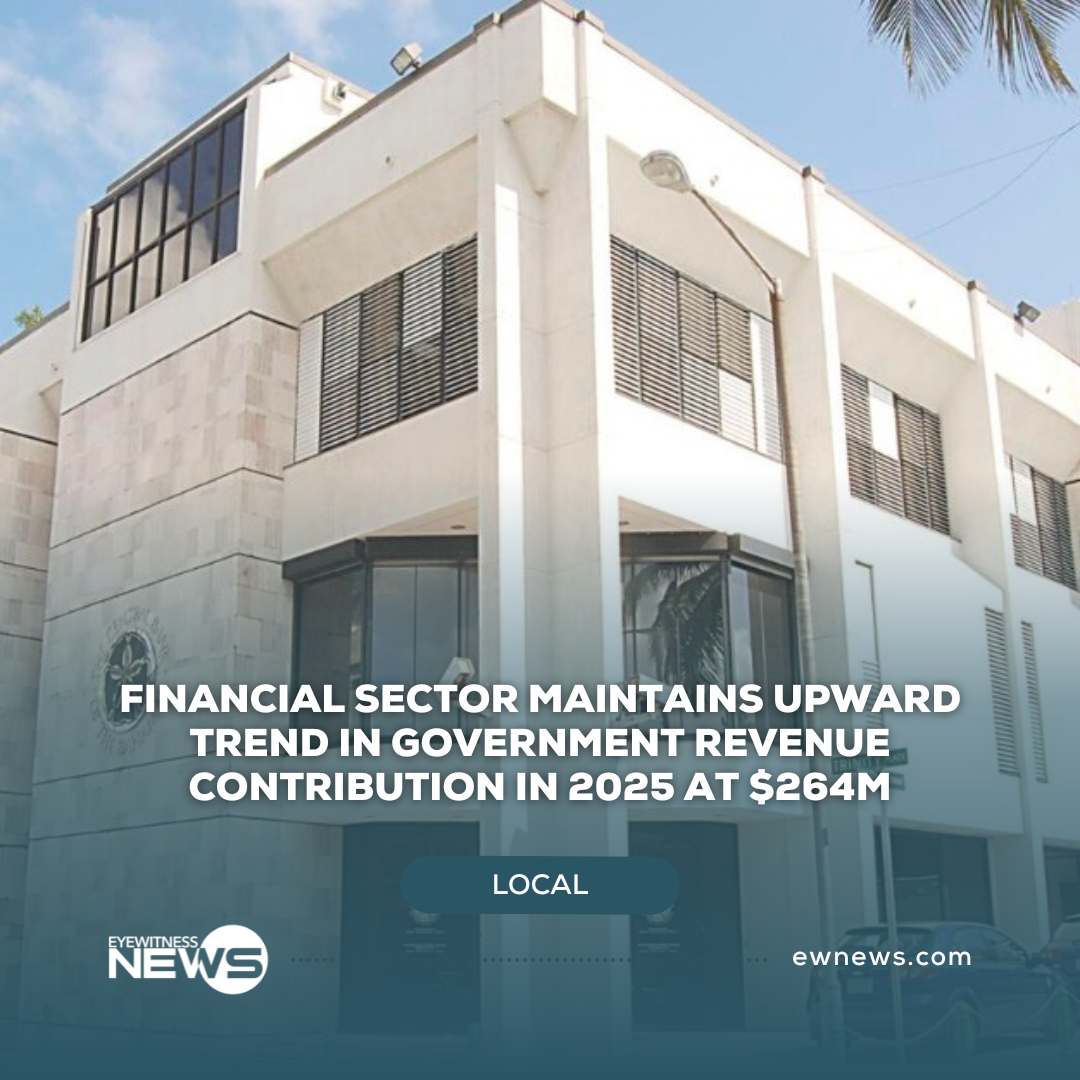
NASSAU, BAHAMAS-The financial sector sustained its contribution to government revenue in 2025, according, with total taxes and fees increasing by $15.0 million (6.0 percent) to $264.0 million according to the latest data from the Central Bank.
According to the regulator in its Gross Economic Contribution of the Financial Sector in The Bahamas (2025), this outturn was supported by a rise in licence and registration fees, which increased by $8.5 million (8.2 percent) to $111.8 million, underpinned by higher receipts from international business company activities, which advanced by $11.6 million (80.1 percent) to $26.1 million. In contrast, revenue from banks and trust companies declined by $3.1 million (4.0 percent) to $74.8 million. Collections from investment funds remained steady at $8.4 million, financial and corporate services providers at $2.3 million, and insurance companies, brokers and agents at $0.3 million.
Revenue from transactional taxes on domestic intermediation activities increased by $6.5 million (4.5 percent) to $152.1 million, driven by gains in insurance premium tax and stamp tax on other banking transactions, which both increased by $4.1 million (11.8 percent and 4.1 percent respectively), as well as stamp tax on instruments and bonds, which rose by $0.7 million (60.8 percent). Offsetting these gains, taxes on mortgages declined by $2.3 million (24.4 percent) to $7.2 million.
Regulatory and supervisory activity intensified across the sector, with continued emphasis on AML/CFT strengthening, tax transparency, and financial stability oversight. Coordination through the Group of Financial Services Regulators supported updates to the national money laundering and financial crime risk assessment, which is expected to inform The Bahamas’ Caribbean Financial Action Task Force mutual evaluation scheduled for 2026. Authorities also issued joint guidance on proliferation financing and sanctions screening, while advancing implementation of OECD Common Reporting Standards. At the Central Bank level, efforts focused on financial inclusion, digital currency awareness, expanded agency banking, and strengthening payment system infrastructure, including development of a Fast Payments System and a cheque reduction strategy. The Central Bank also advanced Basel III implementation, conducted quantitative impact assessments, and contributed to the establishment of the Bahamas Financial Stability Council, bringing together key regulatory agencies to enhance coordination in monitoring systemic risks. Additional reforms were proposed to expand oversight of credit unions and payment service providers, enhance enforcement through administrative monetary penalties, and modernise crisis management frameworks.
The banking and trust sector remained the dominant component of the financial system in terms of balance sheet size and employment, although the number of licensed institutions declined by eight to 184 in 2025. Public banks and trust companies decreased by two to 70, while restricted, non-active, and nominee institutions fell by six to 114. Within public institutions, those providing domestic and international services declined by four to 40, while euro-currency branches remained unchanged at nine. Domestic banking operations accounted for 21 entities, including authorised agents and authorised dealers, with seven clearing banks among them. Despite this contraction, domestic banking assets expanded by 4.6 percent to $12.7 billion, exceeding both the previous year’s growth rate and the five-year average, reflecting continued strength in local financial intermediation. In contrast, international banking assets declined by 4.7 percent to $103.0 billion, reversing modest gains in 2024 and extending the longer-term downward trend driven by consolidation and regulatory restructuring.
Employment in the banking and trust sector declined slightly by seven persons to 3,639 in 2025, representing a 0.2 percent decrease following a 1.0 percent decline in the previous year. Bahamian employment rose marginally by four to 3,452, while non-Bahamian employment fell by 11 to 187, increasing the Bahamian share of total employment to 94.9 percent. Most Bahamian employees were engaged in local banking functions at 68.1 percent, followed by offshore banking at 14.5 percent, trust administration at 12.6 percent, and wealth management-related activities at 4.8 percent. This composition reflected the continued dominance of domestic operations in employment terms despite the scale of international balance sheets.
Total banking sector expenditure increased by $24.6 million (2.6 percent) to $954.6 million in 2025, although growth remained below both the prior year and the five-year average. Operational costs rose by $16.1 million (1.8 percent), with non-staff administrative expenses increasing by $3.9 million to $467.5 million, driven by office rent, professional fees, travel, entertainment, and other administrative outlays. Government fees increased significantly by $21.0 million (17.9 percent) to $138.1 million, while staff training rose modestly by $0.2 million to $2.5 million. Salaries declined by $8.9 million (2.7 percent), marking a reversal from the previous year’s increase. Capital expenditure rose sharply by $8.5 million (60.4 percent) to $22.5 million, reflecting increased investment in fixed assets, renovations, and infrastructure.
A structural distinction between domestic and international banking operations remained evident throughout the year. Domestic banking, which is more retail-oriented and labour-intensive, recorded employment growth of 63 persons (2.2 percent) to 2,981, while international banking employment declined by 70 (9.6 percent) to 658. The ratio of Bahamian to non-Bahamian employees in domestic banking strengthened significantly to 53:1, driven by growth in Bahamian employment to 2,926 and a reduction in non-Bahamian staff to 55. In contrast, international banking saw both Bahamian and non-Bahamian employment decline, with 526 Bahamians and 132 non-Bahamians recorded, maintaining a 4:1 ratio. Average compensation diverged between the two segments, with domestic banking salaries declining by $2,823 (4.4 percent) to $61,042, while international banking salaries increased by $7,200 (6.7 percent) to $114,839.
Domestic banking expenditure grew by 4.3 percent to $744.7 million, with operational costs increasing by 3.2 percent to $724.8 million. Non-staff administrative expenses rose by 2.3 percent to $373.6 million, while staff training declined by 4.8 percent to $1.7 million and salaries fell by 3.1 percent to $222.0 million. Government fees rose by 20.0 percent to $127.5 million, and capital expenditure increased significantly by 66.3 percent to $19.9 million. In contrast, international banking expenditure declined by 2.7 percent to $209.9 million, driven by reductions in operational costs of 3.0 percent, administrative costs of 4.5 percent, government fees of 2.5 percent, and salaries of 1.9 percent, although staff training rose by 48.9 percent and capital expenditure increased by 26.2 percent.
Outside of banking, credit unions recorded strong growth, with total assets rising by $28.9 million (5.6 percent) to $546.7 million, supported by increased deposits and lending activity. Net loans grew by $20.1 million (7.9 percent) to $274.0 million, while funding resources increased by $20.8 million (4.8 percent) to $456.9 million. Investments rose across several categories, including financial investments up $5.2 million (13.8 percent), fixed assets up 8.6 percent, league deposits up 4.2 percent, and non-financial investments up 2.8 percent, while liquid investments declined by $0.9 million (2.3 percent). Expenditure rose by $2.4 million (7.6 percent) to $33.8 million, driven by increases in operational costs, personnel expenses, and other business-related outlays.
The insurance sector recorded modest expansion, with domestic company assets increasing by $131.3 million (6.8 percent) to $2.07 billion. Long-term assets rose by $87.8 million (6.5 percent) to $1.44 billion, while general insurer assets increased by $43.5 million (7.4 percent) to $633.7 million. Employment increased by 50 persons (5.2 percent) to 1,008, with an average salary of $40,089. Although detailed expenditure data was limited, domestic insurers recorded estimated expenditure of $166.1 million, with operating costs accounting for 97 percent of total outlays. The number of licensed insurers, brokers, and agents declined by four to 158.
The securities sector experienced subdued activity, with total regulatory fees declining by 8.0 percent to $11.3 million. Broker-dealer registrations increased slightly to 177, while funds administrators declined to 43 and investment funds contracted significantly by 114 to 545. Net asset value fell by 10.8 percent to $47.5 billion, although financial and corporate services providers increased by 14 to 306, and digital asset registrants rose to 25 from 18.