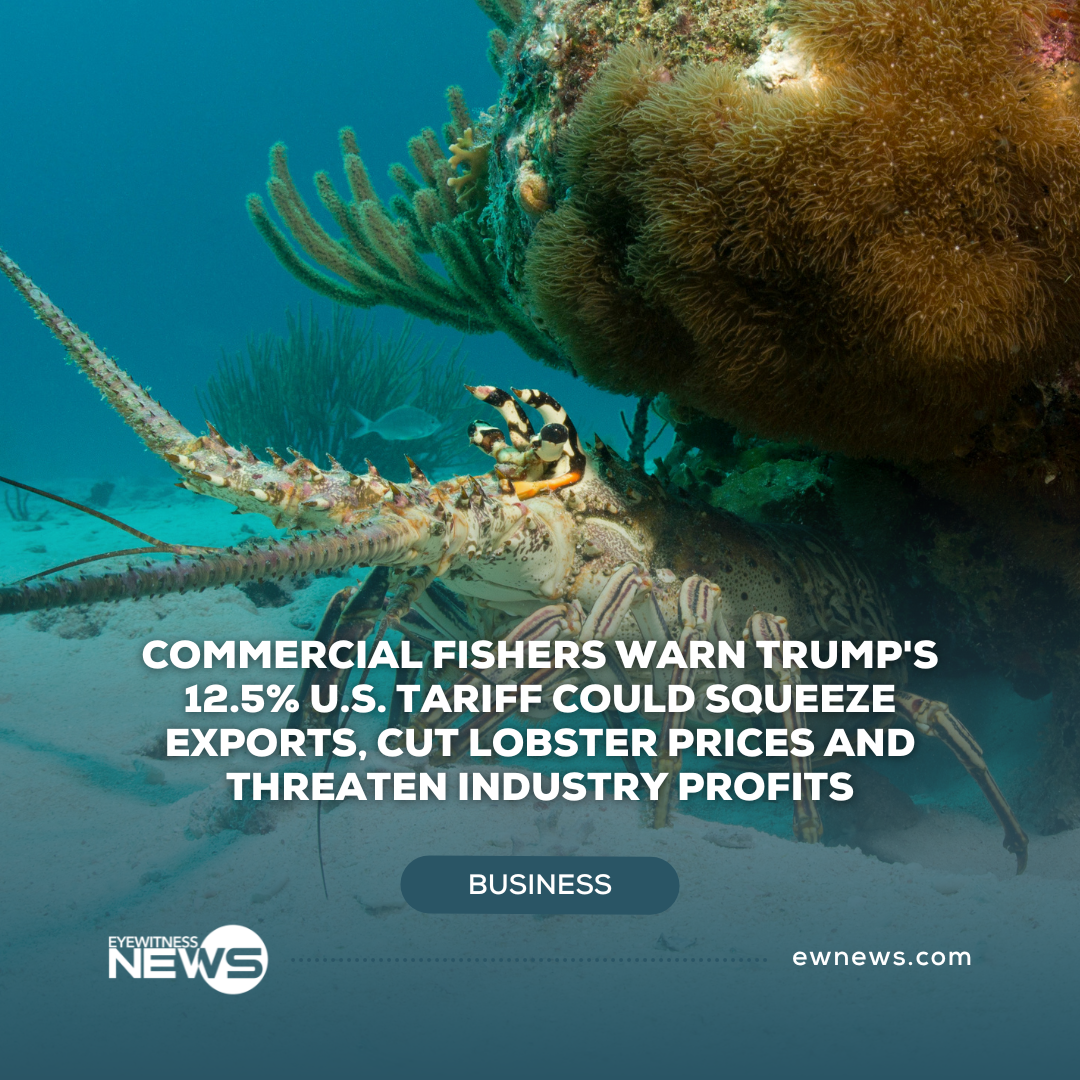
NASSAU, BAHAMAS — Bahamas Commercial Fishers Alliance President Adrian LaRoda says the Trump administration’s planned 12.5 percent tariff on Bahamian exports to the United States could significantly hurt the country’s fisheries sector, warning that the added cost may reduce demand for Bahamian seafood and ultimately leave fishers earning less for their catch.
LaRoda said the industry had initially been relieved when an earlier proposed 10 percent tariff appeared to have been blocked, but the latest announcement has renewed concerns just days before the opening of the 2026 crawfish season.
“If our seafood products become more expensive for the U.S. consumer, they will tend not to want to purchase a more expensive product,” he said. “If the consumer is not buying the product, then the retailer isn’t motivated to buy a product they can’t sell. That trickle-down effect comes back to us.”
He warned that fishers could face the prospect of harvesting seafood without receiving prices high enough to cover their costs.
“What we don’t want to do is harvest products that we can’t sell, or that we can’t sell for the maximum value,” LaRoda said.
The Alliance president welcomed the Bahamian government’s decision to urgently pursue concessions for Bahamian seafood exports, saying the fisheries sector deserves special consideration because of its importance to the economy and its longstanding compliance with U.S. regulations.
“We are an ally,” he said. “Fisheries is one of our main exports. There is no reason to punish us for anything another country may be doing. We’ve met the regulations, including requirements relating to forced labour, so we’re hopeful these tariffs can eventually be reviewed.”
LaRoda noted that fishers have little control over the prices they receive at the start of the crawfish season because export wholesalers negotiate prices with overseas buyers.
He said processors could ultimately pass tariff-related costs down the supply chain.
“We don’t know what we’ll be paid when the season starts,” he said. “A buyer could come back and offer a price that doesn’t even cover what it cost to harvest the product.”
According to LaRoda, harvesting costs can reach between $11 and $15 per pound, leaving fishers vulnerable if export prices fall because of weaker U.S. demand.
He acknowledged that the industry may have to absorb some of the tariff costs rather than lose access to the U.S. market altogether.
“I would prefer to absorb some of that cost than not be able to sell any product at all,” he said, while expressing hope that the burden could be shared across the industry.
LaRoda also cautioned that Bahamian seafood is increasingly competing against lower-priced imports from other exporting countries.
“Our strength has always been quality and consistency,” he said. “But U.S. consumers have increasingly been looking for cheaper products.”
He added that weaker consumer spending and changes within the U.S. restaurant industry have already affected demand for premium seafood products such as lobster and stone crab.
Looking beyond the U.S., LaRoda said the Alliance is actively exploring alternative export markets in Europe and Asia while also pushing for stronger regional shipping links through CARICOM to reduce reliance on U.S. logistics.
He noted that many Bahamian exports currently transit through the United States, exposing exporters to additional costs, including higher shipping expenses linked to U.S. measures affecting Chinese-built vessels.
“We’re not just resting on our traditional markets,” he said. “Markets shift, and we have to adapt. We’re looking at Europe, Asia and better trade routes through the Caribbean.”
Despite the uncertainty, LaRoda said he remains encouraged by the government’s willingness to engage the industry and lobby for relief before the tariffs begin affecting exports.
“We want to be part of the discussions on the way forward,” he said. “Fisheries is one of the pillars of our economy, and we need to protect the industry and the people whose livelihoods depend on it.”