


NASSAU, BAHAMAS: Bahamas Power and Light is preparing for further increases in electricity demand as the summer season progresses and schools prepare to reopen, with officials pointing to extreme heat, rising consumption and ongoing grid challenges as factors placing additional pressure on the system.
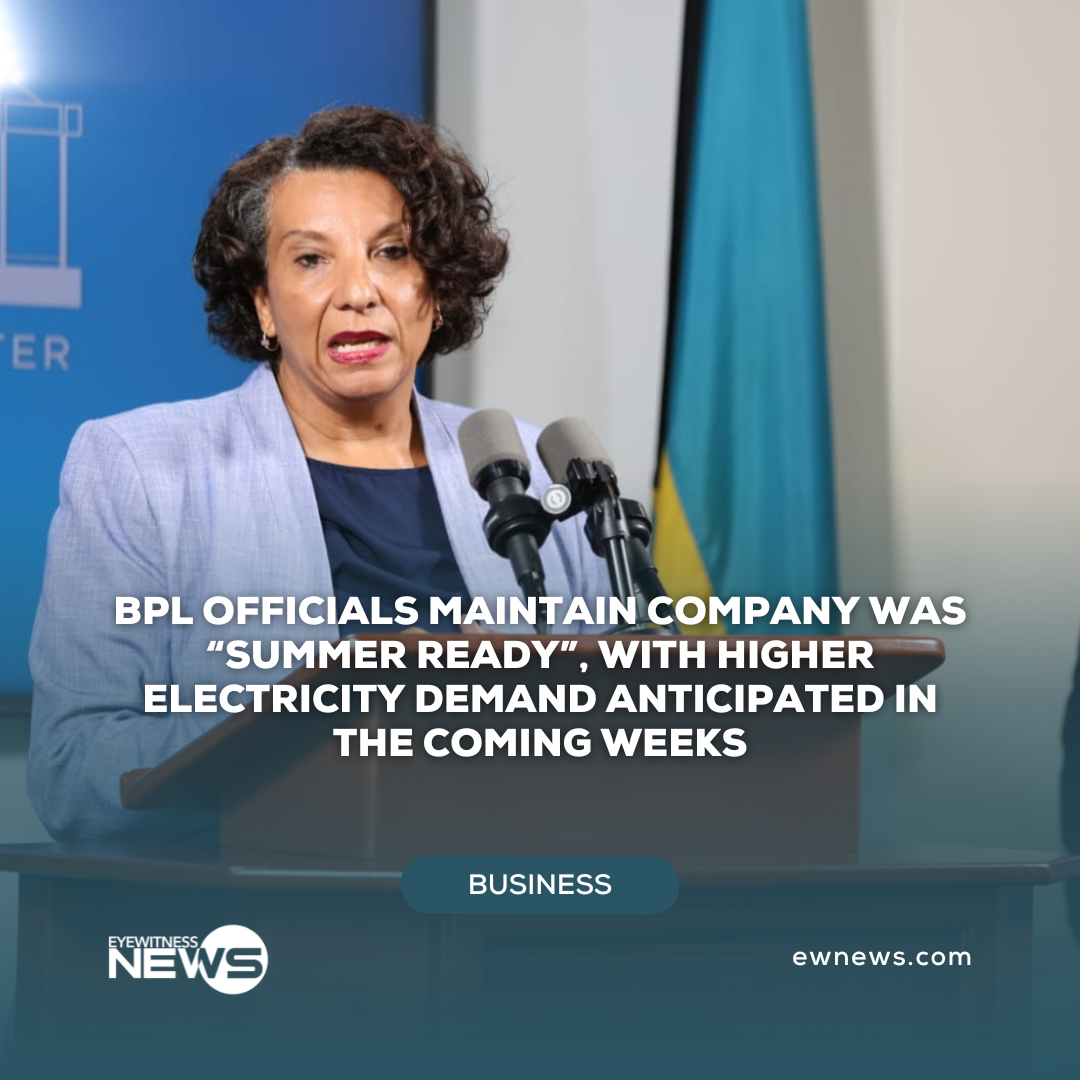
BPL Chairman Christina Alston while speaking at a press conference at the Office of the Prime Minister on Tuesday maintained that the utility is summer ready noting that despite record demand and legacy infrastructure challenges, the company has sufficient generation capacity to meet expected loads.
BPL Chief Operating Officer Anthony Christie said the company currently has enough generation capacity to meet demand on New Providence but expects electricity usage to climb toward the end of August and into September.
“As it stands now, in Providence we have enough generation capacity to meet the demand as it is,” Christie said.
He added: “We do expect increasing those as we approach the end of August and our schools start to open in September. So again, we’re bracing ourselves and preparing to make sure that we have the generation capacity available.”
Christie noted that BPL has encountered several operational challenges in recent weeks, including cable faults, transformer issues and other incidents that disrupted service, but crews have worked to restore power as quickly and safely as possible.
Alston acknowledged that the utility continues to operate under difficult conditions, citing prolonged extreme heat, aging infrastructure and rapidly increasing electricity demand. She noted that BPL has nevertheless prepared for the summer season and continues to maintain reserve generation capacity.
“We’ve already exceeded our peak demand from last year twice,” Alston said.
Alston explained that the system’s annual peak, which typically occurs in September, has already been surpassed in both May and June as hotter temperatures drove increased air conditioning use across New Providence.
“The system peak is going to keep climbing, and as temperatures rise, and as more and more people come onto the grid, the system peak will continue in New Providence.”
Despite those record peaks, Alston emphasized that BPL has maintained sufficient reserve capacity to ensure reliability.
“The thing with that is, though, to note that we have sufficient generation. BPL does a very good job in terms of maintaining contingency.”
Addressing customer concerns over higher electricity bills, Alston explained that neither BPL’s base rate nor fuel charge increased this summer. Instead, the higher bills largely reflect increased electricity consumption caused by prolonged periods of extreme heat.
Alston noted that June experienced significantly more days above 90 degrees than the previous year, causing air conditioning systems to run longer and consume more electricity.
“We’re not getting the temperature differential that we used to have between daytime and nighttime peak.”
Alston added that warmer overnight temperatures mean homes no longer receive the natural cooling they once did, keeping air conditioning units running well into the night and sustaining high system demand.
Energy conservation, Alston said, remains a key part of BPL’s strategy while longer-term infrastructure improvements continue. She pointed to a recent request for government agencies to reduce electricity use, particularly by limiting unnecessary air conditioning in unoccupied buildings, as an example of how conservation can immediately benefit the grid.
“That conservation technique immediately took a load off of the entire grid.”
Alston indicated that BPL intends to continue working with government agencies on conservation initiatives while encouraging households to improve energy efficiency by maintaining appliances, cleaning air conditioning filters and reducing unnecessary electricity consumption. The utility is also launching an energy audit programme this month to help consumers identify where they can reduce usage.
Beyond conservation, Alston highlighted BPL’s ongoing grid modernization programme, which includes integrating Geographic Information Systems (GIS), Supervisory Control and Data Acquisition (SCADA) technology and Advanced Metering Infrastructure (AMI) to improve outage detection and customer communication.
GIS technology is being used to map the coordinates of every electricity customer in The Bahamas, allowing the utility to eventually detect outages automatically rather than relying solely on customer reports.
“We will know when you are out of power. You don’t have to call us, we will know.”
Alston said the objective is to build a smarter electricity network capable of communicating with customers in real time while restoring service more efficiently.
”We want to sit in a world where we can use the SCADA to get the most consumers on in the shortest amount of time.”
While acknowledging customers’ frustrations with recent outages, Alston stressed that BPL’s modernization efforts are designed to reduce both the frequency and duration of future service interruptions.
“The house is under construction, and unfortunately, we’re living through it while it’s under construction.”