NASSAU, BAHAMAS — Bahamas Grid Company (BGC) says it is working to expand its technical workforce while addressing aging infrastructure and reliability challenges across New Providence’s electricity network.
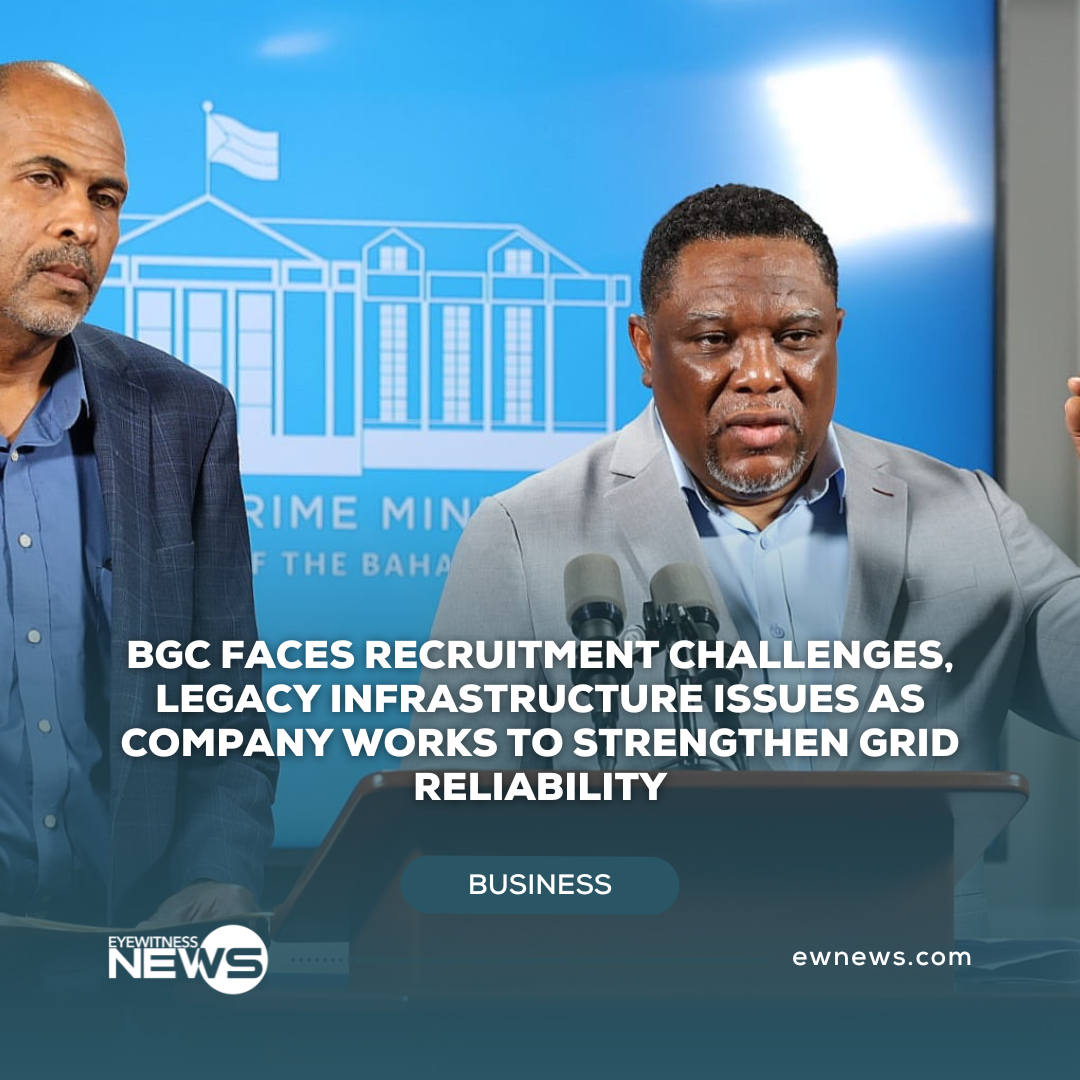
BGC Chief Executive Officer Dareo McKenzie said the company continues to face challenges recruiting skilled technical workers, but is actively increasing its workforce through new hires, former BPL employees and contracted support.
McKenzie said BGC’s target is to have between 160 and 180 transmission and distribution employees, compared to the approximately 100 T&D staff currently on strength.
“Not all 100 are dedicated to line work, and I think that’s perhaps the crux of your question. So I would say approximately 80%, so around 60 to 80 people that are focused on actual line work,” McKenzie said.
He said BGC has relied on several recruitment channels, including partnerships with the Bahamas Technical and Vocational Institute, where the company held a job fair that resulted in new hires.
McKenzie said many of BGC’s experienced employees came from BPL, with some coming out of retirement to support the transition, while contractors continue to provide additional capacity for areas such as streetlight repairs, vegetation management, customer connections and other field services.
“BGC is not only just our employees. We have an augmented workforce as we continue to ramp up to get to the numbers where we need to get to,” he said.
He maintained that staffing levels have not affected BGC’s ability to respond to grid challenges, pointing to the use of its own employees, contractors and support from BPL when necessary.
McKenzie also clarified the separation of responsibilities between BGC and BPL, explaining that BPL remains responsible for generation, while BGC manages transmission and distribution.
“BPL is responsible for the generation, the production of power. BGC, we’re responsible for the transmission and distribution system.”
He said the company inherited a complex network that evolved over 50 to 60 years and now must support modern electricity demands, including increased use of electric vehicles and larger household loads.
“We have that system where it’s essentially a 20th-century system that’s being faced with 21st-century load demands and requirements.”
Meanwhile, BGC Chief Operating Officer Ryan Holder said the company’s assessment shows a clear distinction between the newly completed foundational transmission upgrades and the older distribution infrastructure that continues to experience failures.
Fuller said the transmission backbone — including the new 132-kilovolt substations and transmission lines — is performing well, but challenges remain with older underground cables, substations, transformers and switchgear.
“There’s a clear split between the foundational transmission work that took place. That work’s been completed and is performing well, while the legacy distribution and substation layers of the system are not performing properly.”
He said many of the problems are linked to aging infrastructure that was not designed for current electricity demands, with underground systems especially vulnerable to lightning strikes and water intrusion.
Fuller said BGC is using a strategy called Normalize, Reconfigure and Add, which focuses on repairing faults, optimizing existing assets and adding new equipment and technology.
The company is also preparing a system modelling study to better understand loading conditions, identify weak points and determine where additional feeders, transformers and automated equipment are needed.
Fuller said improved technology will also help BGC better monitor the network through automation and data systems.
“We don’t have visibility on a lot of the old switchgear. So part of the proposed work that’s coming ahead is to add that type of visibility to the system so that there’s awareness as to where outages are occurring and what the loading conditions are.”
He also warned that unauthorized electrical connections are placing additional strain on the network because they create demand that is not visible to system operators.
McKenzie said BGC’s broader reliability strategy includes modernizing the grid, using data-driven investments and creating a digital model of the system to guide future capital spending.
“The work continues and the work goes on. BGC, you are us. We are not only employees within a utility company, but we’re also consumers. So we do feel the pain, and we are committed to improving the system.”