


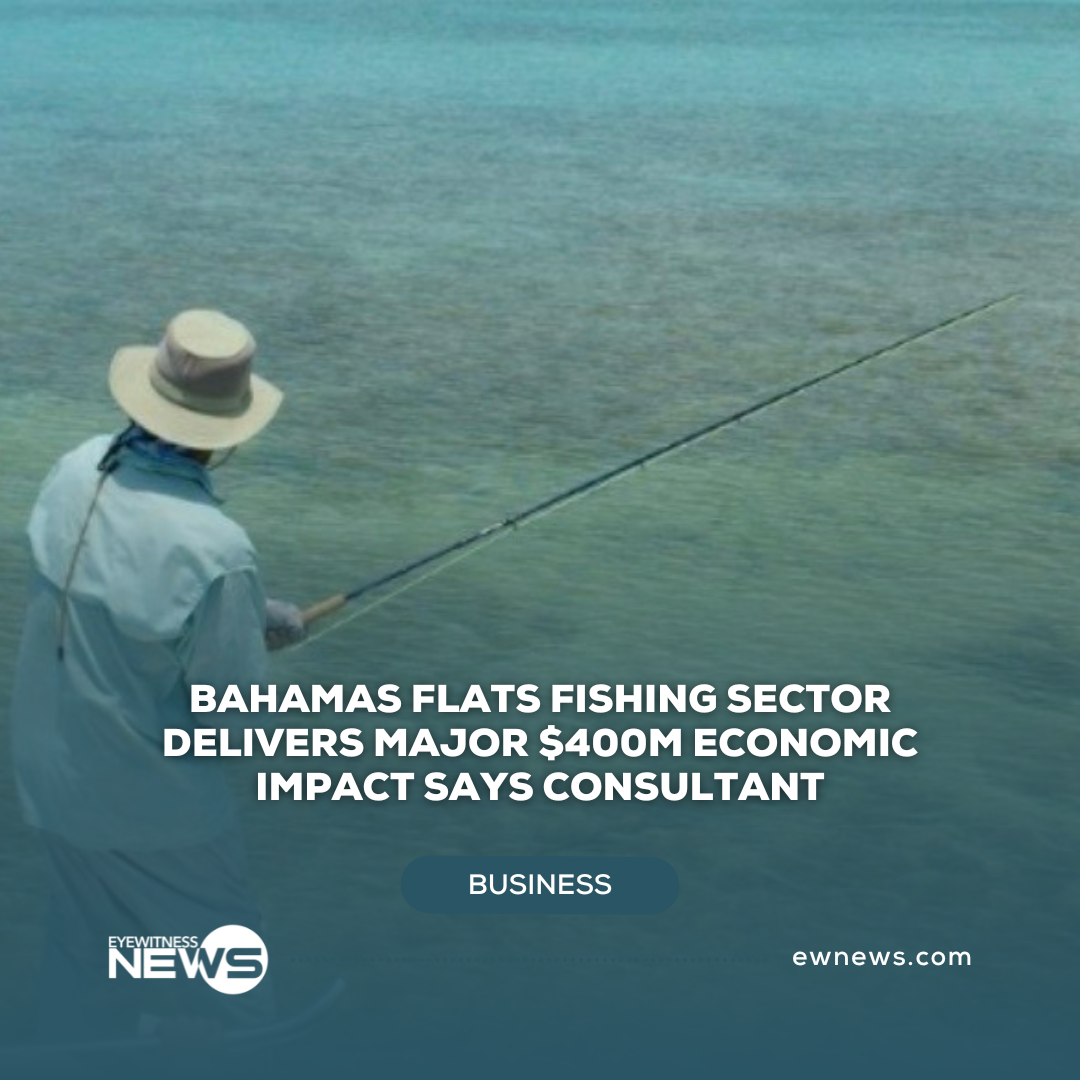
NASSAU, BAHAMAS-The Bahamas’ fly fishing sector is generating an estimated $400 million annually, according to sustainable tourism consultant Joel Moxey, who says the industry has become one of the most powerful economic drivers in the Family Islands and a cornerstone of the country’s sustainable tourism economy.
Joel Moxey made the comments while delivering a presentation at the Andros Business Outlook Conference on Thursday, where he outlined the current state of the flats fishing industry, its global competitiveness, and the opportunities and risks facing the sector.
Speaking on the geography of the Bahamas, Moxey described the country as uniquely positioned in the Western Hemisphere for flats fishing tourism, pointing to its extensive shallow-water systems and marine environment.Moxey said the country’s marine geography gives it one of the largest shallow-water systems in the region, which is critical for bonefishing and fly fishing tourism.
“We have more shallows in the Western Hemisphere than any other country combined,” Moxey said. “That is what gives us our unique geographical composition for flats fishing.”
Moxey also highlighted the country’s climate as a key advantage, noting that water temperatures remain suitable year-round for saltwater fly fishing.
“We are in a temperate zone where water temperatures are generally between 80 degrees in summer and not less than 60 degrees in winter,” he said. “That is perfect for bonefishing and all of the species that make up flats fishing.”
He described the Bahamas as a premier global destination for warm-water fly fishing, noting that while destinations such as Belize, Mexico, and Venezuela also compete in the space, the Bahamas remains widely regarded as the leading location.
“When you are talking about saltwater fly fishing, the Bahamas is the premier destination in that conversation,” he said.
Moxey further pointed to natural assets such as mangroves, reef systems, and extensive flats as central to the industry’s value.
“We are a warm climate, enormous marine resource, and a premier bonefishing destination,” he said. “We have about 100 square miles of flats, the largest concentration of mangroves in the Western Hemisphere outside the Amazon, and the third largest barrier reef in the world.”
He also referenced recent scientific findings suggesting reef resilience in parts of the Bahamas and other global locations.
“Some of the most significant reefs recently found have been in the Bahamas, Australia, Cuba, and the Pacific,” he said.
Moxey told the conference that accessibility, hospitality, and skilled labour also strengthen the country’s tourism offering.
“We are English-speaking, we have experienced and well-trained fly fishing guides, and we are easy to get to,” he said. “You can get here in a day from the west of the Mississippi now with improved airlift. And we are a friendly people—once you arrive in the Bahamas, you know it is a different experience.”
He also noted that the industry operates across a wide range of price points, from high-end fishing lodges to smaller local operations.
“There is a wide range of accommodation price points,” he said. “You can find very high-end lodges or smaller, more local fishing operations.”
Moxey traced the origins of flats fishing in the Bahamas back to the 1920s, particularly in Bimini, where early anglers began exploring backcountry waters.
“Fly fishing and bonefishing in the Bahamas started in Bimini during the era of rum running,” he said.
Turning to the global market, Moxey highlighted the scale of recreational fishing in the United States as a major opportunity for the Bahamas.
“There are 58 million Americans engaged in recreational fishing, contributing over $230 billion to the U.S. economy and supporting 1.1 million jobs,” he said.
He added that even a small share of that market would have significant implications for the Bahamian economy.
“Let’s put that in perspective: the GDP of the Bahamas is about $16 billion,” he said. “Ten percent of that fishing spend is already more than our entire GDP. That shows the scale of the opportunity.”
Moxey also cited demographic trends within the fishing industry, including participation growth among women and younger anglers, noting that early exposure often leads to lifelong engagement.
He estimated that fly fishing is one of the strongest economic contributors in the Family Islands.
“Fly fishing is the largest economic generator in the Family Islands,” he said. “Nothing comes close—around $400 million a year. It is four to five times the commercial fishing industry.”
He pointed to high demand for travel to fishing destinations such as Andros, Acklins, and Crooked Island, noting that limited flight availability is often tied to fishing demand.
“You try getting on a flight to Acklins or Crooked Island—you will find they are booked with fly fishermen,” he said.
Moxey also referenced earlier research by Dr. Tony Fedler, which estimated the industry’s impact at tens of millions of dollars annually, as well as a 2016 UN Food and Agriculture Organization assessment which found that recreational fishing in the Bahamas outperformed commercial fishing in economic value.
He said those figures have grown significantly in the years since.
“Based on growth since 2016, it is conservatively estimated at $400 million annually,” he said.
Despite the industry’s strength, Moxey warned of several challenges, including weak management of flats resources, illegal fishing activity, lack of certified guides in some islands, and limited access to financing for operators.
“Uncontrolled proliferation of lodges is a concern,” he said. “We also have fishing pressure and a shortage of trained, certified guides in some islands.”
He also raised concerns about environmental threats, particularly coastal development and mangrove destruction.
“Block creeks and mangrove restoration is critical,” he said. “If we destroy the coastal environment, we are essentially destroying the flats and the reef system that supports this industry.”
Moxey pointed to past canal development and coastal modification projects as having long-term ecological impacts, while noting ongoing restoration efforts in parts of the country.
He said improving environmental management, licensing, and enforcement is key to sustaining the industry.
The Ministry of Tourism, he noted, has established a dedicated flats fishing development unit, while other agencies such as the Department of Marine Resources, the Port Department, the Small Business Development Centre, and the Bahamas Development Bank are all playing roles in supporting the sector.
He said these institutions are helping with training, financing, safety regulation, and business development for industry operators.
“Over $800,000 has been provided in grants, but many operators were not ready because they lacked basic licensing and business compliance,” he said. “If you want to grow this industry, you have to be properly licensed and structured.”
Moxey said the sector offers significant opportunities for rural development, job creation, and entrepreneurship if properly managed.
“It creates jobs, builds sustainable economies, and keeps communities vibrant,” he said.
He concluded by stressing that the fly fishing industry is both an economic and environmental asset that must be carefully protected.
“When visitors come to fish the flats, they are investing in our environment and our economy,” he said. “Restoring mangroves and protecting bonefish habitat is not just conservation—it is good business.”