


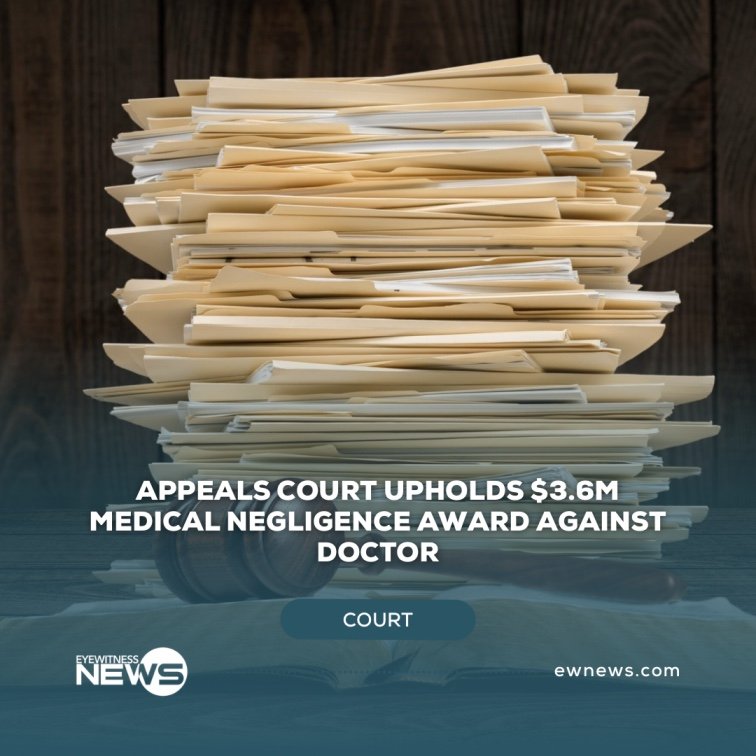
NASSAU, BAHAMAS: The Court of Appeal has upheld a Supreme Court judgment finding obstetrician Dr. Gregory Carey liable for medical negligence in the delivery of a baby who suffered catastrophic brain injuries, dismissing his appeal and leaving intact an approximately $3.6 million damages award. The infant, identified only as TK was represented by King’s Counsel Krystal Rolle and Darron Cash.
In its judgment, the appellate court concluded that Dr. Carey failed to demonstrate that the trial judge was “plainly wrong” in finding that his management of the delivery fell below the accepted standard of medical care and caused the child’s permanent injuries. The court also ordered that Dr. Carey pay the costs of the appeal.
The case arose from the August 2012 delivery of an infant identified only as TK at Princess Margaret Hospital. Court records show what had been an uneventful pregnancy became a medical emergency after Dr. Carey spent about 25 minutes attempting an assisted vaginal delivery using first a vacuum extractor and then forceps. Neither instrument successfully delivered the baby before consultant obstetrician Dr. Harold Bloomfield was called to assist.
By the time TK was delivered, he was unresponsive, had a poor Apgar score, blue skin and the umbilical cord wrapped around his neck. Although he was resuscitated and transferred to the Neonatal Intensive Care Unit, he later developed severe neurological conditions, including cerebral palsy, epilepsy and other permanent disabilities. The judgment notes that at the time of the trial, approximately 10 years later, TK remained in a vegetative state.
In the original negligence action, TK, through his parents, alleged that Dr. Carey’s repeated use of both a vacuum extractor and forceps, together with the prolonged delivery, caused irreversible brain damage. Dr. Carey denied negligence, arguing that the vacuum equipment was defective, that the instruments themselves did not cause injury and that TK’s condition resulted from other medical causes, including possible congenital abnormalities.
After hearing evidence from medical experts on both sides, the trial judge concluded that Dr. Carey breached the required standard of care by attempting sequential operative deliveries and that those decisions caused TK’s injuries. The judge awarded approximately $3.6 million in damages.
On appeal, Dr. Carey argued that the judge wrongly preferred the evidence of the child’s experts over his own expert, failed to properly assess the delivery attempts, incorrectly rejected his arguments concerning hospital equipment, erred in analysing causation, delayed too long in delivering judgment and improperly assessed damages.
The Court of Appeal rejected each of those arguments, finding that the trial judge was entitled to prefer the evidence of the child’s medical experts after carefully assessing the reasoning, consistency and reliability of the competing opinions. The judges stressed that the weight given to expert evidence depends on its logic and consistency with the facts, not whether the expert practises in The Bahamas or overseas.
The appellate court also upheld the finding that Dr. Carey’s use of a vacuum extractor followed by forceps fell below the accepted standard of care. It agreed with the trial judge that the evidence supported the conclusion that the vacuum extractor did not fail because it was defective, but because it had been improperly applied, resulting in repeated “pop-offs.” The court further found that attempting forceps after the failed vacuum extraction, despite the baby’s head being malpositioned, was inconsistent with accepted obstetrical practice.
The court rejected Dr. Carey’s argument that deficiencies in hospital equipment relieved him of responsibility, finding that as the attending physician he had a duty to determine whether the equipment was suitable before using it and that the evidence supported the conclusion that the problem lay in how the instruments were used rather than any equipment failure. It also dismissed arguments that TK’s injuries stemmed from genetic or other unrelated causes, concluding that the trial judge had properly analysed causation and was entitled to find that the negligent management of the delivery caused the child’s lifelong injuries.
Addressing complaints about the delay in the trial judge’s decision, the Court of Appeal acknowledged the delay was undesirable but found it did not undermine the safety of the judgment because the judge remained fully engaged with the evidence and no prejudice had been shown. The court likewise found no basis to disturb the damages award, noting that Dr. Carey had made no substantive submissions on damages during the trial.