


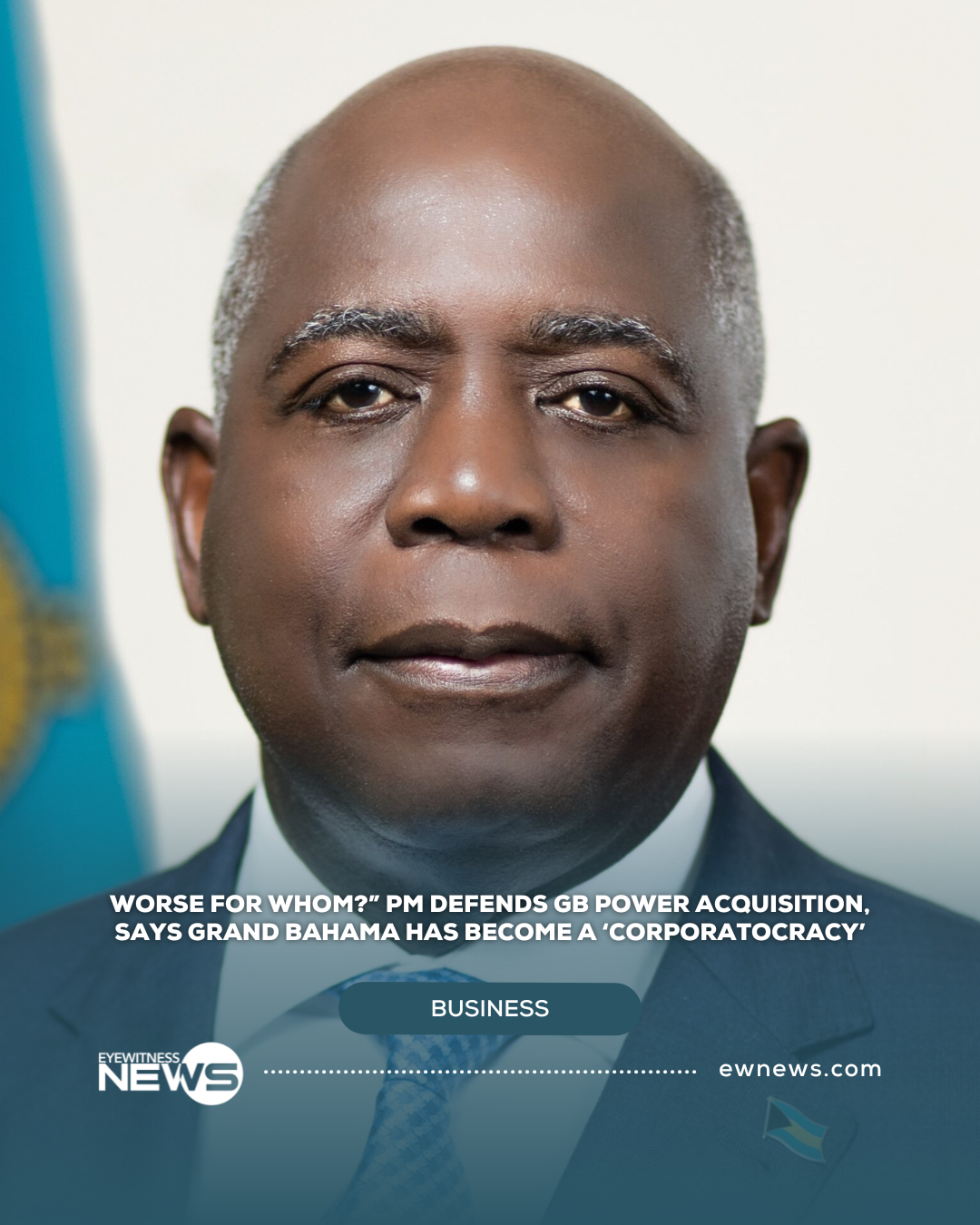
NASSAU, BAHAMAS — Prime Minister Philip Davis has defended the Government’s plan to acquire Grand Bahama Power Company, dismissing warnings that public ownership would damage the island’s economy and asking critics, “Worse for whom?” as he outlined electricity rate disparities and structural reform plans.
Delivering the keynote address at the 27th Annual Grand Bahama Business Outlook, Davis noted that the Government has signed a Memorandum of Understanding with Grand Bahama Power to explore acquiring Emera’s shares in the utility. He framed the move as part of a national energy reform strategy aimed at equalizing electricity rates and integrating Grand Bahama into a unified planning framework.
“So when a chamber or a commentator says, ‘Leave the existing arrangement alone, government will only make it worse,’ I ask a simple question: Worse for whom?” Davis said, referring specifically to the proposed government takeover of the power company.
Separately, the Prime Minister criticized the island’s broader governance structure under the Hawksbill Creek Agreement, describing it as having evolved into what he called a “corporatocracy,” where corporate interests and private agreements became more influential than public institutions.
“In a corporatocracy, the question is not ‘What is best for Grand Bahama?’ but ‘What is acceptable to a small group of companies?’” he said.
Davis cited differences in electricity pricing between Grand Bahama and New Providence as justification for reform. Residential customers using between 351 and 800 kilowatt hours pay a base rate of 22.87 cents per kilowatt hour with Grand Bahama Power, compared to 11.95 cents charged by Bahamas Power and Light (BPL). For usage above 800 kilowatt hours, the rates are 27.31 cents in Grand Bahama versus 14.95 cents in New Providence.
He also noted higher reconnection fees, meter testing charges and temporary disconnection costs on Grand Bahama.
According to Davis, government ownership would pursue three objectives: enabling universal electricity rates across The Bahamas, allowing integrated national energy planning and aligning energy policy with household and economic needs.
He pointed to approximately $1 billion in committed national energy investments in LNG, solar, microgrids and grid upgrades, including a $100 million Bahamas Grid Company bond in 2024, a private equity raise in 2025 for solar and LNG projects and a subsequent $100 million bond for Island Power Producers that exceeded its target.
Beyond energy reform, Davis updated attendees on infrastructure projects, including a signed agreement with Manchester Airports Group to redevelop the Grand Bahama International Airport. Phase one, valued at approximately $130 million, includes a new terminal with U.S. pre-clearance and expanded apron space. Work began in January.
He also addressed the Grand Lucayan resort, noting that a Heads of Agreement was signed in May 2025 with Concord Wilshire Group, with remediation and branding negotiations ongoing.
Davis placed the reforms within the context of national fiscal recovery following Hurricane Dorian and the COVID-19 pandemic, which he said caused an estimated $13.1 billion in combined losses. He noted that debt-to-GDP has declined to approximately 70 percent and the deficit-to-GDP ratio to 0.5 percent, with Moody’s recently upgrading The Bahamas’ outlook to “positive.”