


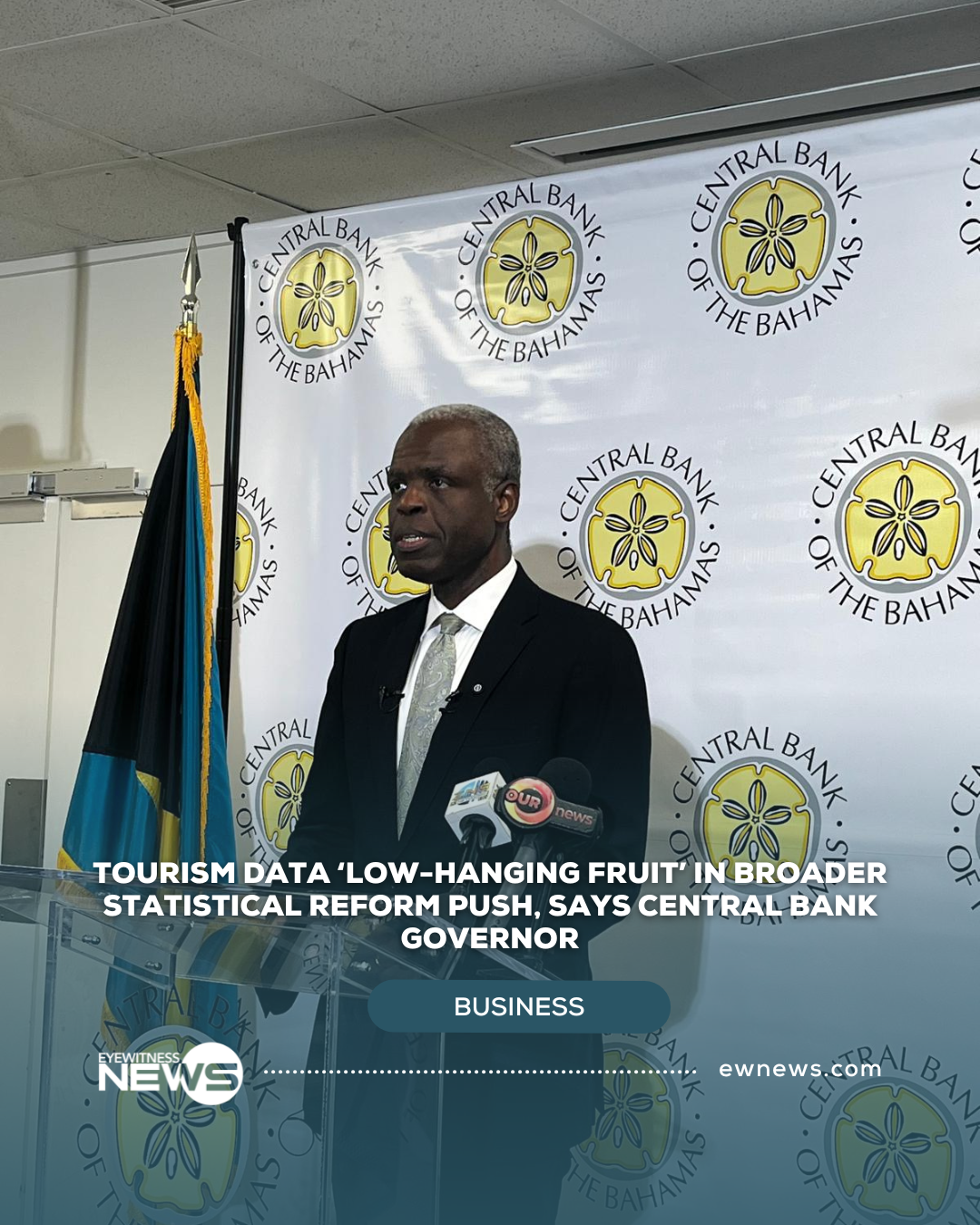
NASSAU, BAHAMAS- While calling tourism the “lowest hanging fruit” for statistical reform, Central Bank Governor John Rolle emphasized that The Bahamas must also improve how it tracks private sector activity— such as real estate transactions, foreign investment, and Bahamian-owned assets abroad.
A recent IMF report has warned that inflated visitor spending estimates may be obscuring deeper economic vulnerabilities.
“I will say this so that everyone’s minds can be at ease, the tourism sector in the Bahamas is the lowest hanging fruit in terms of improving data that describes this economy,” Rolle said during the regulator’s quarterly press briefing.
The recent IMF assessment suggested that The Bahamas may be overstating how much tourists spend, inflating its “travel credits” in the balance of payments and potentially leaving an almost $1 billion hole in the national accounts if those numbers are adjusted.
Governor Rolle acknowledged that while tourism is the most visible area for statistical upgrades, the underlying challenge is broader. “We need to improve the estimate of what’s happening in the Bahamian private sector,” he said, adding that outdated surveys and limited reporting by businesses hamper visibility not just in tourism, but also in real estate, foreign investment, and offshore capital flows.
The IMF report noted that current estimates rely heavily on old visitor surveys and assumptions. With more recent Ministry of Tourism data indicating lower revenue than reported by national statistics, the IMF says the country’s Net Errors and Omissions (NEOs) — a measure of unexplained discrepancies in external transactions — could swing to a negative $923 million, or 6.5% of GDP.
Governor Rolle noted that the Central Bank, working with stakeholders, is already “scoping” ways to improve those estimates. “It’s not just about tourism,” he said. “When the Central Bank looks at its trade and external sector statistics, we look at how we can better estimate the size of investment or capital stock in The Bahamas, how much of it is owned by non-Bahamians, and we also have an assignment to estimate the capital stock that Bahamians own abroad.”
The IMF also flagged that billions in offshore flows linked to shell companies, investment funds, and foreign-owned financial institutions are not being captured in official reporting. In 2023, countries such as Luxembourg and Singapore reported over $90 billion in investments from The Bahamas — a number local officials couldn’t reconcile with what’s reported domestically.
Governor Rolle emphasized that the technical assistance from the IMF is aimed at overhauling the country’s economic measurement systems, not just refining tourism metrics. “It’s a holistic approach,” he said, “focused on how we estimate trade statistics, including what’s happening in real estate transactions.”
While the Central Bank has made progress collecting more detailed data from banks, insurers, and investment vehicles, Governor Rolle acknowledged that capturing accurate private sector and offshore data remains a major task.