


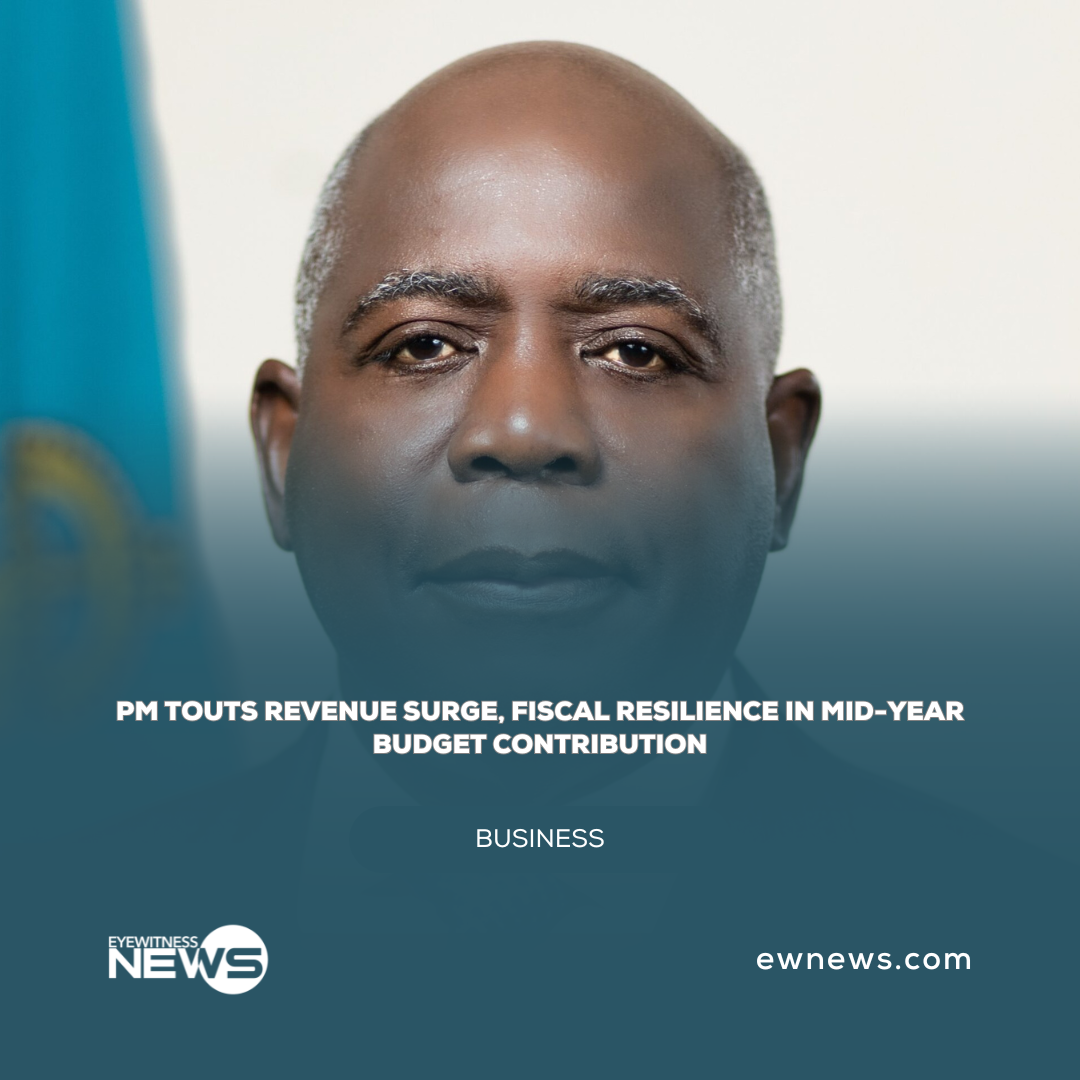
NASSAU, BAHAMAS- Prime Minister Philip Davis KC declared that the Bahamian economy is demonstrating “continued growth and resilience,” pointing to stronger revenues, an improved primary balance, and disciplined fiscal management during his contribution to the Mid-Year Budget in the House of Assembly.
“The improved revenue performance recorded over the first six months of the current fiscal year is a clear reflection of the continued growth and resilience of the Bahamian economy,” Davis said as he outlined the Government’s financial position at the halfway mark of fiscal year 2025/2026.
Total revenue collections reached an estimated $1.5 billion, a $66.6 million increase over the same period last year. Tax revenues totaled $1.3 billion, with value-added tax collections amounting to $739.1 million at the half-year mark.
“VAT performance in The Bahamas has continued to strengthen during the first half of this fiscal year,” Davis said, noting that the improvement “has not been driven by higher rates, but by stronger compliance, more effective enforcement, and better administration across the tax system.”
He added, “This steady flow of VAT reductions reflects our commitment to the Bahamian people that where fiscal space allows, relief will follow,” referencing earlier reductions in VAT rates and the planned move to make unprepared foods fully VAT-exempt next month.
On the spending side, preliminary aggregate expenditure totaled $1.9 billion for the six-month period. The resulting net deficit stood at $342.4 million, an improvement of $25.3 million over the previous year. More notably, the primary balance improved to a $3.1 million deficit compared to a $32.3 million deficit in the same period last year.
Central government debt increased to $12.4 billion at the end of December 2025, equivalent to 75.1 percent of GDP, reflecting net borrowing activities during the period.
Under the Public Finance Management Act, Davis reported that total outstanding obligations amounted to $241.9 million at mid-year, including $60.5 million in arrears from prior fiscal years and $181.4 million in unpaid invoices from the current fiscal year.
“This level of outstanding balance reflects the interaction of project execution, support for essential services, and seasonal cash flows,” he said, adding that the Government is “strengthening commitment controls, improving cash forecasting, and prioritizing structured arrears reduction – all within the broader fiscal consolidation framework to maintain debt sustainability and deficit reduction targets.”
Addressing Opposition concerns about the $265.3 million transferred into the National Investment Fund, Davis stated: “That transfer was fully authorised by Parliament under the Resolution passed on March 10, 2025,” adding that “suggestions that the transfer bypassed Parliament or misrepresented the fiscal position are not supported by the facts.”
Davis also referenced continued economic expansion, with real GDP growth of 3.4 percent in 2024 and unemployment declining to 9.3 percent in the second quarter of 2025.
Amid geopolitical tensions affecting global oil markets, he reassured Bahamians, saying, “Rest assured Mister Deputy Speaker, we are fully committed to working on behalf of every Bahamian to reduce the cost of electricity and fuel prices.”
Highlighting tourism-led growth, Davis pointed to major cruise investments, including Celebration Key opened by Carnival Cruise Line and the Royal Beach Club on Paradise Island launched by Royal Caribbean International, describing them as part of a broader national strategy to sustain economic expansion over the next three years.
With pension obligations projected to soar to $4.1 billion by 2032 and already consuming nearly 6.2 percent of recurrent expenditure in just the first half of the current fiscal year, Prime Minister Philip Davis also noted that administration is moving ahead with sweeping reforms to protect retirees while safeguarding the country’s long-term fiscal stability.
Davis described pension liabilities as “another pressing fiscal challenge” confronting The Bahamas and signalled that structural change is no longer optional.
“In response, we are advancing comprehensive pension reform through new legislation that will transition the system toward a funded, defined contributory model,” the Prime Minister said.
The Government’s obligations to public service retirees are projected to reach $4.1 billion within the next seven years, placing mounting pressure on public finances as the administration works to stabilise debt levels and strengthen its fiscal position.
Davis revealed that the Ministry of Finance has already prepared a white paper outlining the reform framework.
“This represents a major milestone in the Government’s commitment to modernising the public pension framework in a manner that safeguards the retirement security of public officers while strengthening the long-term fiscal sustainability of the country,” he said.
Under the proposed system, both employees and the Government will contribute to individual pension accounts under a rate structure still to be determined.
“Under the policy framework both employees and, the employer, which is the government, will contribute under a rate framework that will be determined,” Davis stated.
He said the new model will introduce key protections designed to modernise the system while maintaining security for public officers and their families.
“Contributions will be credited to individual pension accounts, protected against negative investment returns. It provides for immediate vesting of employee contributions, graduated vesting of employer contributions, and flexible retirement benefit options, including lump-sum payments or lifetime annuities,” he said.
The Prime Minister added that survivor and disability protections will remain integral to the framework.
“In cases of death or permanent disability, accrued benefits will be payable to the employee or designated beneficiaries, ensuring security for families and dependents,” Davis noted.
He positioned pension reform as part of a broader strategy to address fiscal risks ranging from climate-related disasters and state-owned enterprise liabilities to healthcare and cybersecurity threats, but made clear that pension costs represent one of the most significant long-term pressures on the national budget.