


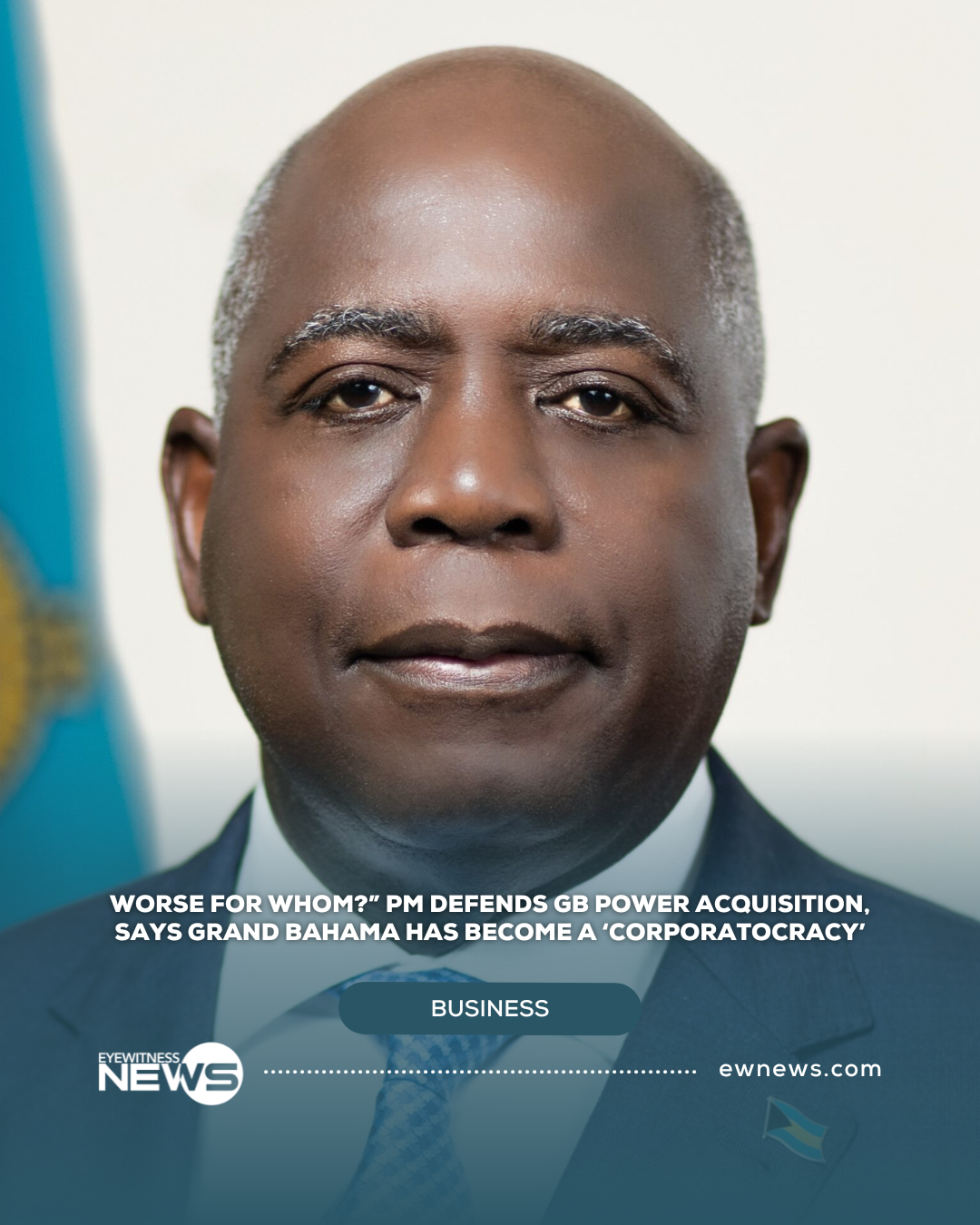
NASSAU, BAHAMAS- Prime Minister Philip Davis says The Bahamas must deliberately leverage its more than 12 million annual visitors to overcome what he describes as the country’s “critical mass” challenge.
Speaking at the Bahamas Business Outlook, Davis pointed to population size as one of the country’s most persistent structural limitations, particularly for Grand Bahama’s economic expansion.
“We lack the critical mass,” Davis said. “We welcome over 12 million visitors to our shores a year. So the way we address it is to include those visitors and craft policies and initiatives to take advantage of that additional mass that comes in.”
The Prime Minister argued that economic planning in The Bahamas cannot rely solely on resident population figures. Instead, he said policymakers must treat visitor flows as an extension of the domestic market — designing infrastructure, investment strategies, and commercial initiatives to capitalize on that scale.
For Grand Bahama, Davis said momentum is beginning to build. He pointed to the opening of Celebration Key, ongoing shipyard construction, and what he described as visible signs of returning residents and investment activity.
“I’m noticing myself that I’m seeing vehicles on the road in Grand Bahama with Nassau tags from other parts of the country,” he said. “That’s a sign to me that they are coming back.”
However, he cautioned that critical mass will “always be a challenge” for a small island nation — particularly as global demographic trends shift.
Davis noted that declining birth rates are becoming a worldwide issue, referencing population contractions in industrialized nations such as Japan and the United States. He suggested that The Bahamas must also confront its own demographic realities.
“Bahamians have stopped having children,” he said. “But if you see what’s happening globally — the world is being depopulated particularly in some of hat we call the industrial centres.”
Beyond population growth, Davis said mindset shifts are equally important. Reflecting on his early years in Grand Bahama, he acknowledged that newcomers are sometimes viewed with skepticism.
“When I first came to Grand Bahama, they used to call me ‘driftwood,’” he said. “But one of the things is perhaps revising our own mindset and understanding the issue of critical mass.”
Turning to governance in Grand Bahama, Davis addressed questions about the balance between central government oversight and the Freeport port area’s quasi-independent structure under the Hawksbill Creek Agreement.
He said any permanent governance adjustments for the port area would be shaped through consultation with licensees, who he argued must play a more active role in shaping policy direction.
“You have the port area and you have the licensees who ought to be playing a very instrumental and meaningful role in deciding what happens,” he said. “A number of licensees have abdicated their voice in shaping what ought to be happening in the port area.”
“We are one country,” he said. “There has to be equity of services, equity of costs, equity of delivery of government services and an atmosphere where businesses can thrive and people can meet their full potential.”
He added that governance arrangements for the port area would be developed collaboratively, while West and East Grand Bahama remain squarely within central government’s remit.