


NASSAU, BAHAMAS — The Bahamas must ultimately improve the diversification of its exports to enhance its resilience to external shocks according to a draft of the country’s National Trade Policy.
The draft document which gives a thorough background analysis of The Bahamas’ trade performance and its underlying challenges has noted that overall exports of The Bahamas performed well until the outbreak of the COVID-19 pandemic.
“They increased steadily from about BSD $400 million in 2016 to BSD $537 million in 2019 (equivalent to an average annual increase of 10.1 percent), but then dropped by 37.7 percent in the COVID-19 year of 2020, to BSD $335 million. However, more than half of The Bahamas’ exports are re-exports of products that were previously imported. Also, the share of genuine “domestic exports”, i.e. exports of goods produced in The Bahamas decreased from 50 percent in 2016 to 38 percent in 2019. The recovery to 48 percent in 2020 is not necessarily an indication of increased competitiveness but rather of the issues faced by the logistics industry and tourism sector in the pandemic year,” the document stated.
It was noted that the export statistics do not capture all actual exports, as they tend to exclude sales made to tourists. While they are in the country; these are registered as domestic sales although, in fact, they constitute (indirect) exports.
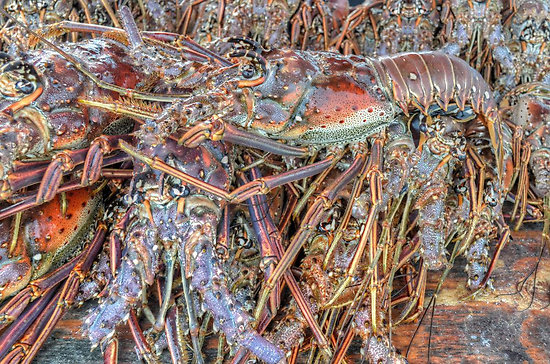
“The portfolio of goods and services exported by The Bahamas is not diversified. Among goods, in 2019, the top four export products (at tariff line level) accounted for 90 percent of total domestic exports: spiny lobster tails (BSD $72.6 million; 35.8 percent), polystyrene (BSD $67.9 million; 33.5 percent), organic chemical compounds containing a pyrimidine ring (BSD 32.3 million; 15.9 percent), and sea salt (BSD $10 million; 4.9 percent),” the document noted.
Provisional data for 2020 indicated that the pandemic has led to an even stronger export concentration than before. Additionally, one of the dominant exports, polystyrene beads, “has shown a long-term decline in export value, from a maximum of BSD $182 million in 2013 to BSD $69 million in 2019, and BSD $55 million in 2020 – in large part in response to increasing environmental concerns in many markets over the use of plastics packaging and corresponding bans”.
Concentration is also high in terms of export markets – The Bahamas’ goods trade is concentrated on very few partners with the first and foremost being the United States followed by the European Union. Among services, the vast majority of exports are tourism and travel services.
The document notes that “ultimately, export diversification is necessary to enhance the country’s resilience to external shocks,” while acknowledging that there are limits to the level of diversification that can be achieved by a small economy such as The Bahamas.
It was noted that greater focus will be placed on products and sectors that are based on locally available raw materials such as further marine products, selected agricultural products such as cascarilla, or the creative industries.