


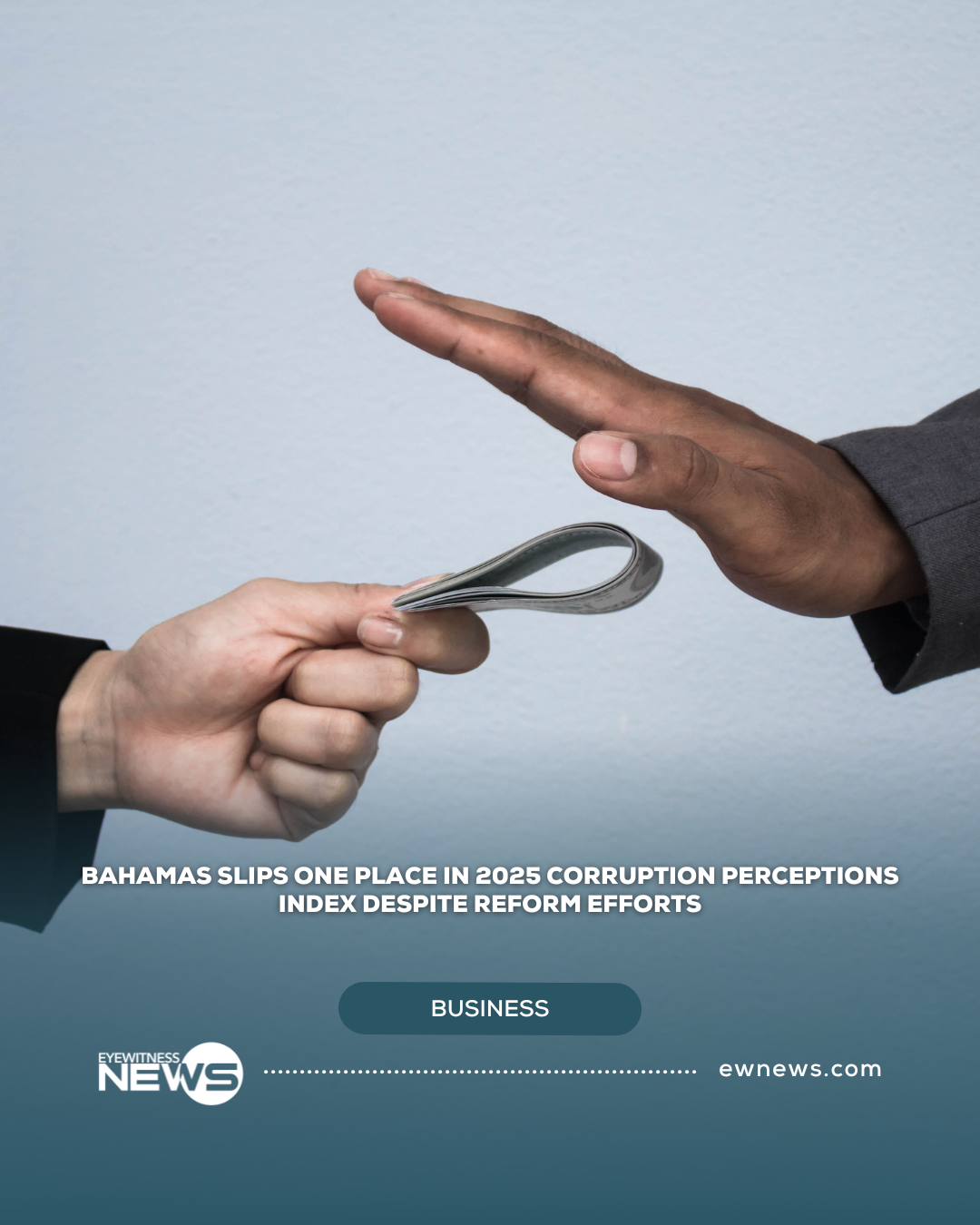
NASSAU, BAHAMAS — The Bahamas has recorded a decline in both score and ranking in Transparency International’s 2025 Corruption Perceptions Index (CPI), highlighting a growing gap between recent legislative reforms and public confidence in how those measures are applied in practice, according to the Organization for Responsible Governance (ORG).
The CPI, regarded as the world’s most widely used global corruption benchmark, measures perceived levels of public-sector corruption based on assessments by experts and business leaders. For 2025, The Bahamas scored 64 out of 100, a one-point decline from its 2024 score. The country has remained in the mid-60s range for roughly the past decade and ranked 29th out of 182 countries in the 2025 index. A lower score typically signals concerns around accountability, transparency, and the consistent enforcement of rules—factors closely monitored by investors, international partners, and multilateral institutions.
According to ORG, the downgrade comes in a year marked by notable policy and legislative activity aimed at strengthening governance frameworks. Among the measures passed were the Independent Commission of Investigation Act 2025 and the Protected Disclosures Act 2025. The Government also took steps to enhance compliance with Financial Action Task Force (FATF) standards on anti-money laundering and counter-terrorism financing, expanded the publication of government contracts under the Public Procurement Act, and signed the Escazú Agreement, committing to improved access to information, public participation, and justice.
Despite these initiatives, the Organization for Responsible Governance (ORG) said the CPI outcome suggests that reforms have not yet translated into widespread confidence in how public decisions are made or enforced.
“The CPI reflects how corruption risks and accountability are perceived through independent data sources and assessments by experts and business leaders,” ORG said in a statement. “A decline signals that reforms, while important, are not yet consistently visible, clear, or trusted in everyday experience.”
According to ORG, public perception over the past year has been influenced by several high-profile matters involving questions around the transparency of public contracts, as well as allegations and convictions involving public officials. These developments, the organization noted, shape how fairness and equality before the law are judged, regardless of legislative progress.
Transparency International’s leadership has underscored the broader economic and social implications of weak anti-corruption enforcement. Its Chief Executive Officer stated: “To improve people’s lives and build resilience to organised crime, governments must put the fight against corruption at the centre of their agenda.” The message, ORG said, is particularly relevant for small, open economies that depend on investor confidence and strong international relationships.
Matthew Aubry, Executive Director of ORG, said the results demonstrate that legal reforms alone are not enough to shift public sentiment.
“The CPI shows that passing laws alone does not build trust. People judge integrity by what they see and feel in their day-to-day lives: how decisions are made, whether processes are clear, and whether accountability is consistent,” Aubry said. “When those signals are mixed, confidence breaks down, even when reforms are underway.”
He added that perceptions of corruption have direct consequences for everyday economic life, particularly for communities with limited access to power and opportunity.
“Corruption affects people’s daily lives, especially in communities with the least access to power and opportunity,” Aubry said. “But those same communities also have the power to drive change and insist that accountability is visible, shared, and enforced.”
From a business perspective, governance credibility plays a critical role in determining the cost of capital, regulatory risk, and long-term economic competitiveness. International lenders, credit rating agencies, and foreign investors routinely factor CPI performance into country risk assessments, particularly in jurisdictions seeking to attract diversified investment beyond tourism.
As the country approaches its next national election cycle, ORG said the focus should shift from legislative intent to measurable outcomes. The organization has urged closer scrutiny of how transparency laws are implemented, whether independent oversight bodies are adequately resourced, and how equal access to economic opportunity is ensured in practice.
“The foundations for stronger integrity are increasingly in place,” ORG noted, “but turning reform into trust will depend on accountability working consistently in everyday practice.”