


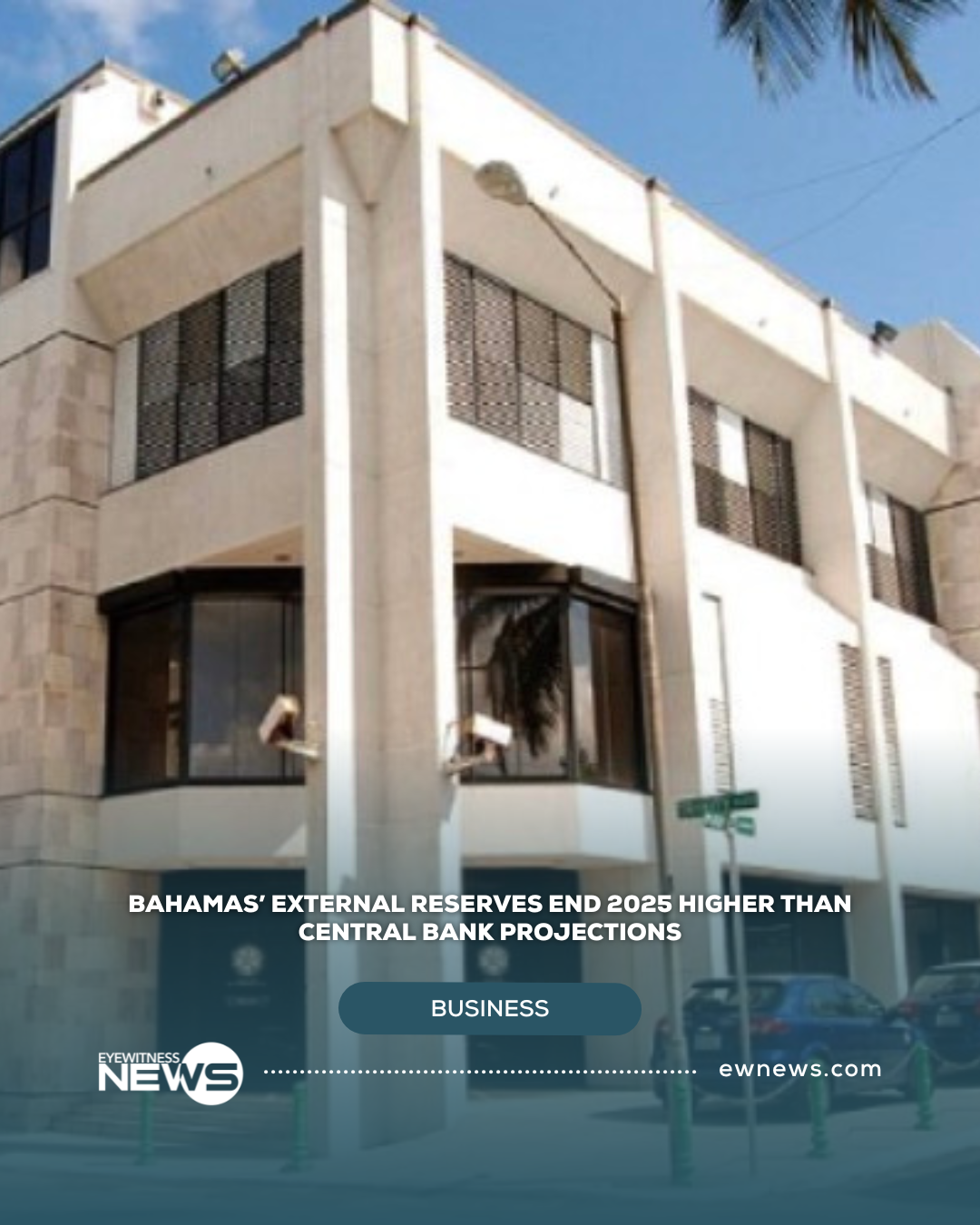
NASSAU, BAHAMAS- The Bahamas’ external reserves ended 2025 stronger than expected, with the Central Bank estimating balances at $2.9 billion at the start of February 2026—about $200 million higher than a year ago.
Central Bank Governor John Rolle said the stronger-than-projected outcome reflected robust inflows from tourism, foreign investment, and prudent management of public sector borrowing.
“Foreign exchange market activities strengthened in 2025, aligned with inflows from tourism, investments, and other private sector activities,” Rolle said during the quarterly economic briefing. “Commercial banks’ total purchases of foreign exchange from the private sector increased by 4.1 percent to $7.6 billion, up from an estimated 2.2 percent in 2024. In line with increased demand for foreign exchange for imports and other payments, commercial banks’ total sales to the private sector also expanded by 5.1 percent to $7.5 billion.”
While net sales of proceeds to the Central Bank were lower than in 2024, external reserves grew by $170 million, compared with $115 million the previous year. Rolle noted, “This was because the Central Bank also made a modest net purchase of foreign exchange from the public sector, as opposed to a small overall net sale the previous year.”
The Central Bank had forecasted potentially lower end-of-year reserve levels, based on expectations of faster private sector credit growth. However, unanticipated net retention of public sector borrowing, lower imported fuel costs, and earnings from invested external balances all contributed to the stronger outcome. “External reserves continue to be healthy overall, and able to tolerate an increased pace of private sector credit lending, which the Central Bank is also accommodating,” Rolle said.
On private sector credit, growth moderated in dollar terms to almost $330 million in 2025, down from $350 million in 2024, representing a slowed rate of increase of 5.5 percent compared to 6.1 percent previously. Rolle said, “While mortgages grew by a lesser amount than the year before, consumer credit expanded by almost the same amount, and commercial lending was accelerated.” The delinquency rate for loans three or more months behind in payments decreased to 5.0 percent from 5.5 percent, signaling lower lending risks.
Bank liquidity trends were mixed. “During 2025, bank liquidity, measured by excess reserves, decreased by $40.2 million, overturning the $18.2 million accumulation in the preceding year. However, excess liquid assets, a broader measure, grew to $151.2 million from $75.9 million a year earlier,” Rolle explained.
In December 2025, excess reserves fell $104 million to $1,845 million, while excess liquid assets declined $59.3 million to $3,111.3 million. On a year-to-date basis, excess reserves decreased $40.2 million, but excess liquid assets increased by $151.2 million, nearly doubling growth in the previous year.
December foreign exchange trends also revealed that net sales to commercial banks narrowed to $34.6 million from $57.1 million, while net sales to the public sector increased to $49.3 million from $29.9 million. Overall, he emphasized that the stronger external reserves position “provides the economy with resilience and the flexibility to support continued private sector lending and fiscal consolidation.”