


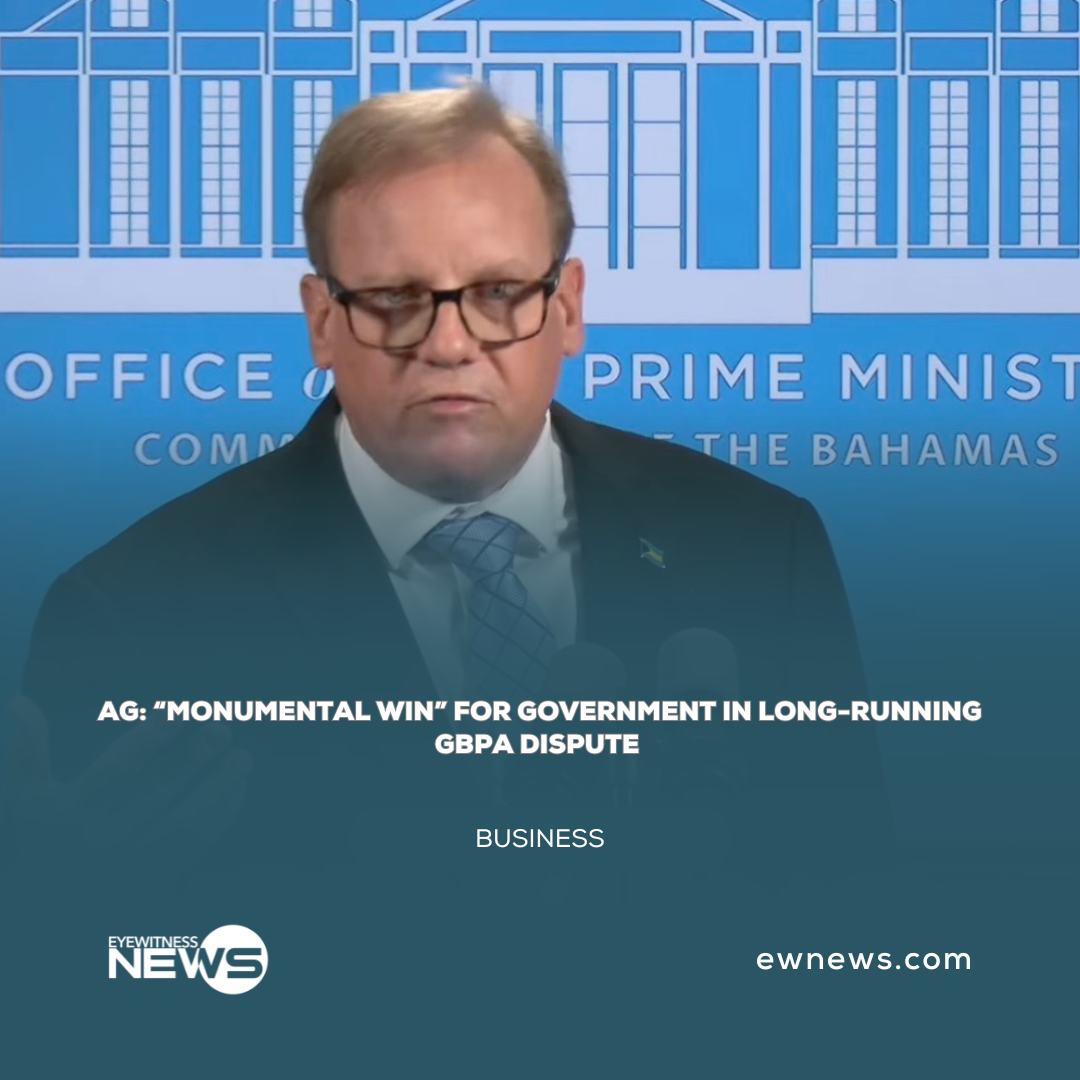
NASSAU, BAHAMAS- Attorney-General and Minister of Legal Affairs Ryan Pinder KC today described a Partial Award in the arbitration between the Government and the Grand Bahama Port Authority (GBPA) as a “monumental win for the Government,” declaring that the ruling secures long-term financial accountability for the benefit of Bahamian taxpayers and firmly clarifies governance in Freeport.
Speaking at a press conference at the Office of the Prime Minister Pinder said the outcome of the arbitration Tribunal represents “good news for the people of Grand Bahama, and good news for all Bahamian taxpayers.”
“As many of you know by now, there has been a partial award by the arbitration Tribunal in the Government’s case against the Grand Bahama Port Authority and the Port Authority’s counterclaims against the Government,” Pinder said.
“The key outcome is good news for the people of Grand Bahama, and good news for all Bahamian taxpayers: the Tribunal confirmed that the Grand Bahama Port Authority has an ongoing contractual obligation to make annual payments to the Government, for the benefit of the Bahamian taxpayer, for the remainder of the term of the Hawksbill Creek Agreement, until 2054.”
He explained that the amount of the payments will be determined through a contractual review mechanism.
The Government had sought reimbursement for costs associated with the administration of Freeport under clause 1(5)(d) of the Hawksbill Creek Agreement (HCA). However, the Tribunal held that clause 1(5)(d) “could not be invoked, since the clause had been replaced by a provision of an agreement between the parties in 1994.”
Under that 1994 agreement — entered into when the tax concessions under the HCA were extended — the GBPA committed to pay $500,000 per annum for five years from 1995 to 2000, after which payments due to the Government would be subject to a review.
“The Tribunal held this contractual review mechanism remains operative and enforceable, notwithstanding it has not been enforced for many years,” Pinder said. The Tribunal further held that it is “self-evident that the Government can invoke the Review for future Years,” confirming it “remains fully enforceable” and rejecting any suggestion that the review provisions had become inoperable.
The Government filed its Notice of Arbitration on May 3, 2024, seeking reimbursement of costs incurred in the administration of Freeport. On June 3, 2024, the GBPA responded, indicating it would defend the claim and assert counterclaims “for substantial damages and other relief, in respect of multiple breaches on the part of the Government.” The Tribunal issued its Partial Award on February 26.
“The Government has succeeded in establishing a liability by the GBPA to pay money annually to the taxpayer for the remainder of the term of the HCA (until 2054),” Pinder said.
While the Tribunal has not yet determined the quantum of the sums due to the Government, that issue will be addressed in the next phase of arbitration.
On the question of damages, Pinder said: “The Tribunal has not determined the quantum of the sums due to the Government from the GBPA. That will be the subject of the next phase of the arbitration.”
He emphasized that liability has been clearly established.
“What they did decide on was that liability does in fact exist, and that liability that does in fact exist under paragraph 3 of the 94 agreement is, but it is almost identical in scope to what we could expect under 15D,” Pinder told reporters.
“If you ask me what my opinion is, my opinion is that our claim and the full amount of our claim still stands. It still stands, and we will look forward to a review with the Grand Bahama Port Authority of the parameters of what they owe the taxpayers of the Commonwealth of the Bahamas, and if they are unable to come to an agreement with the government on a rational basis of determining what those expenses are, we will ask the Arbitration Tribunal to undertake that.”
Pinder broke down the Partial Award into what he described as two major determinations.
“It established that there is liability of the Grand Bahama Port Authority to reimburse the government of the Bahamas and the taxpayers of the Bahamas for administrative expenses incurred in Freeport by the government. It ruled that that liability absolutely exists.”
“The second thing this arbitration award actually did was it clearly defined the roles of the government and the Port Authority with respect to the governance of Freeport. Those two are absolute in this award.”
He said remaining open issues include how expenses will be calculated if the parties cannot agree, and whether damages apply historically as well as prospectively.
“What is the applicability of those damages historically rather than prospectively? That hasn’t been decided in this award, and that will be something that the tribunal takes up and decides as well.”
The GBPA had filed eight counterclaims, originally seeking $1 billion in damages against the Government for what it alleged was wrongful interference in the administration of Freeport.
“GBPA’s case that it has the sole right to administer Freeport and to deal with licensing, immigration, customs, utilities, land purchases, development/environmental approvals, was entirely rejected by the Tribunal,” Pinder said.
Pinder noted that the Tribunal rejected a series of claims brought by the Grand Bahama Port Authority (GBPA), affirming the Government’s authority across multiple regulatory areas in the Port Area. It ruled that the Government is entitled to require approval for GBPA licences issued to non-Bahamian persons, noting that since 1968 licence applications have been referred to the Government and withheld if objections were raised — a practice applied “without question for over half a century.”
He further noted that the Tribunal also held that the Government can lawfully regulate immigration and operate a customs regime in the Port Area, with immigration and customs controls to be standardized and coordinated with those in the rest of The Bahamas. Additionally, Pinder noted that the Tribunal dismissed GBPA’s claims that it was the sole regulator of electricity and other utilities, confirming the Government’s right to legislate in that area. It upheld the requirement for non-Bahamians to register with the Foreign Investments Board to acquire real property under the Immovable Property (Acquisition by Foreign Persons) Act 1981 and the International Persons Landholding Act 1993, and rejected GBPA’s challenge to the Government’s authority to implement an environmental approval regulatory regime for developments in the Port Area.
The only issue on which the Tribunal found a breach related to the Government’s failure to give timely consideration to the approval and promulgation of three sets of environmental bye-laws first proposed by the GBPA in December 2006 Pinder noted. However, the Tribunal stated it could not “immediately see a basis for assessing the damages to which the GBPA is entitled.”
Pinder stressed the broader governance implications of the ruling.
“The Partial Award affirms that administration of the Port Area is not exclusively vested in the GBPA. At most, the GBPA retains specific contractual administrative responsibilities. But these operate alongside – and subject to – the Government’s continuing powers.”
He added that attempts to exclude the Government from involvement in the administration of Freeport “would have had a significant governance impact as to Freeport,” and that the GBPA’s effort to secure substantial taxpayer-funded damages “would have had significant fiscal implications.”
When asked about the Government’s original claim of $357 million and suggestions that it did not receive that amount, Pinder responded: “That the arbitration tribunal did not rule on the award, quantum of the award. What they asked the parties is to adopt a different category that imposed the liability, and that requirement, paragraph 3 of the 1994 agreement, requires the parties to have a review.”
“If the parties cannot agree on that review, they are ready and willing to rule on the amount of damages owed to the government for the reimbursement of expenses.”
On costs, he acknowledged: “I don’t know today. It’s not cheap. I mean, granted that, it’s not cheap for us. It’s a two year arbitration.” He added that the issue of costs between the parties remains outstanding and was not ruled on in the Partial Award.
Looking ahead, Pinder said: “The Government will now work to have the remaining issues resolved as quickly as possible. In practical terms, the annual review process can commence immediately in respect of future years (from 2023 onwards).”