


NASSAU, BAHAMAS — The Water and Sewerage Corporation (WSC) has lost its final appeal in a long-running property dispute after the Privy Council ruled that the state-owned utility failed to establish ownership of land in Mangrove Cay, Andros, on which it constructed water storage infrastructure.
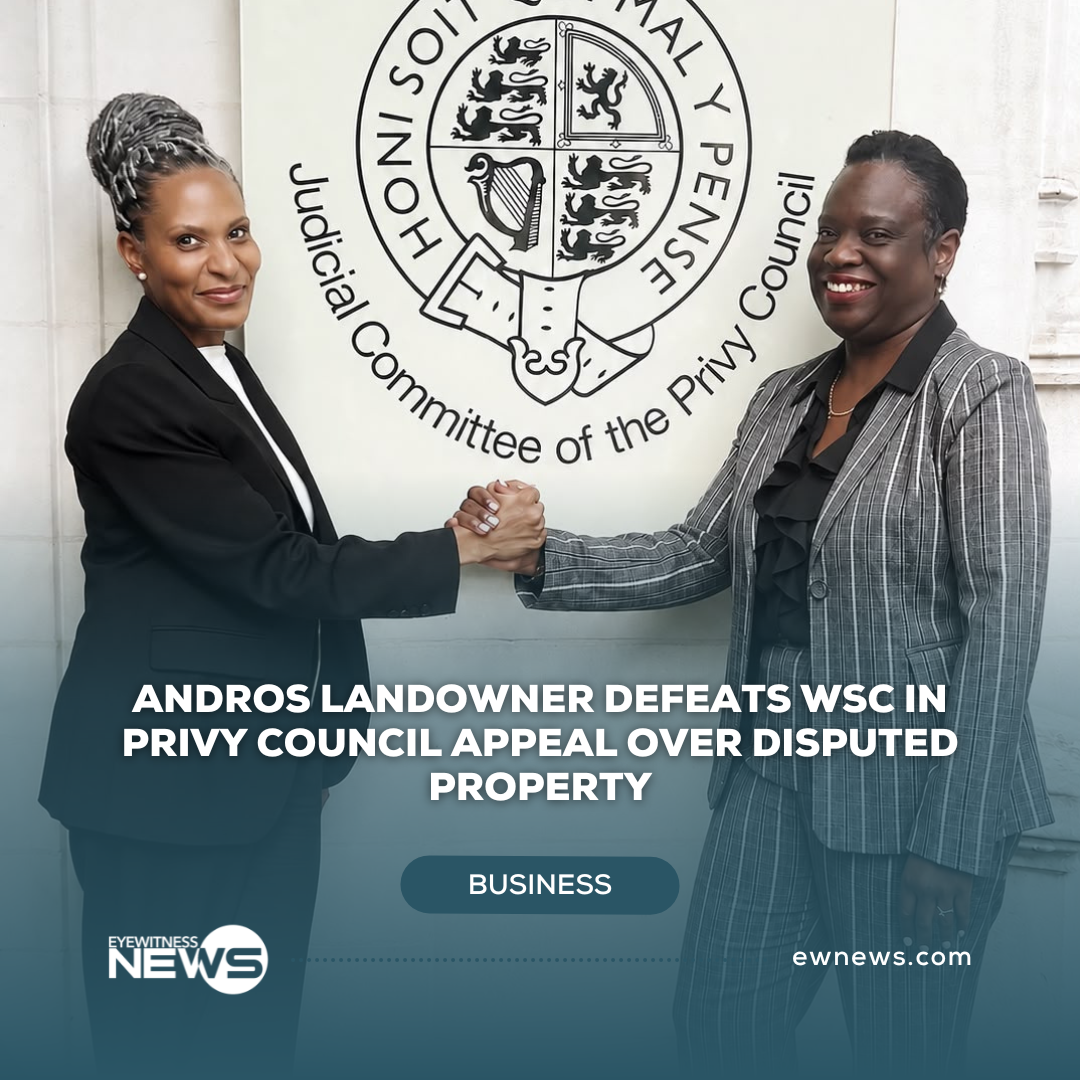
The Judicial Committee of the Privy Council dismissed WSC’s appeal against Carla Anita Cecilia Braynen Turnquest, upholding a Court of Appeal decision that she had established a documentary title sufficient to bring a claim for trespass and recovery of possession.
The dispute concerns approximately one-third of an acre containing a short access road, two water storage tanks and associated piping used to supply the Mangrove Cay community.
Turnquest was represented before the Privy Council by Krystal D Rolle KC and Darron B Cash, instructed by Rolle & Rolle. WSC was represented by Dywan A G R Rodgers and Katharine Bailey.
The ruling, delivered on September 21, brings clarity to the competing rights of documentary titleholders and parties claiming ownership through adverse possession. It also leaves WSC facing Turnquest’s claim for damages for trespass and delivery of possession of the property.
Turnquest claimed she inherited the land from her father, Carl Braynen, who acquired it under a 1963 conveyance involving a larger parcel originally connected to the estate of his grandfather, Albert Braynen.
WSC did not claim to possess documentary title. Instead, it argued that it had acquired the land through adverse possession because it had erected and maintained two water storage tanks and related equipment there from around 1983.
Turnquest initially lost the case before Supreme Court Justice G Diane Stewart in December 2022. The judge found that the 1963 conveyance was not a good root of title because it did not adequately describe the land and there was insufficient evidence showing how it had come into Albert Braynen’s ownership.
However, the Court of Appeal reversed that decision in December 2023, finding that Turnquest’s documentary title was superior to WSC’s possessory claim and that the corporation had failed to demonstrate the necessary intention to acquire the land through adverse possession.
The Privy Council upheld that outcome, although it cautioned that the Court of Appeal went too far in suggesting that any documentary title, regardless of its defects, would automatically defeat a possessory claim.
The Board found that Turnquest was not required to prove the same quality of title that would be demanded from a vendor selling land. In a trespass action, the court is primarily concerned with the relative strength of the competing claims.
“The court is concerned only with the relative strengths of the titles proved by the rival claimants,” the judgment noted, citing an earlier Privy Council authority.
The Board determined that the 1963 conveyance, when read alongside the 1875 will of William Henry Sweeting and survey evidence, sufficiently identified the land inherited by Turnquest.
It accepted that a reference to “860 acres” in the conveyance was a drafting mistake. The document had been prepared by Carl Braynen, who was described as a realtor and had no formal legal training.
“Properly interpreted, the 1963 Conveyance identified and was intended to convey the same piece of land that had been bequeathed to Phoebe Ann Braynen in the Sweeting Will,” the Board found.
The Privy Council was particularly critical of the evidence supporting WSC’s adverse-possession claim, describing it as “sparse.”
WSC relied partly on a 1983 Ministry of Works and Utilities memorandum referring to difficulties maintaining the Mangrove Cay wellfield and water distribution system. However, the Board found that the document did not identify the disputed land or refer to water tanks or other facilities located on it.
“Except for the vague, unsubstantiated and second-hand evidence of Mr Gibson, there was simply no evidence as to when WSC had made the access road or installed either of the storage tanks or other apparatus on the Land,” the judgment said.
The Board also found no evidence showing when WSC performed any act demonstrating an intention to exclude others from the property. There was no evidence of signage asserting ownership, while the only fence was around the newer cylindrical tank and there was no evidence establishing when it was installed.
WSC’s own conduct after Turnquest raised the trespass claim also undermined its assertion of ownership.
After her attorney wrote to the corporation in November 2012, WSC requested time to investigate the title. In April 2016, it asked Turnquest to provide proof of ownership and proposed either purchasing the land outright or entering an extended lease.
Turnquest subsequently sought $20,000 in partial settlement of her claim. WSC issued a cheque for that amount, describing it as “the initial payment for use of private land by the Corporation in Mangrove Cay, Andros.”
The Privy Council said WSC’s offer to purchase or lease the property, followed by its $20,000 payment for the use of private land, was inconsistent with an intention to possess the property as owner.
The Board ultimately concluded that Turnquest had established a documentary title enabling her to pursue claims for trespass and delivery of possession, while WSC had failed to prove adverse possession for the required limitation period.